Plastic Card Printer Price Range Guide: Find Your Budget
Table of Contents []
- Your Complete Plastic Card Printer Price Range Guide from Plastic Card ID
- What Actually Drives the Cost of a Card Printer
- Entry-Level Card Printers: The $300-$700 Range
- Mid-Range Card Printers: The $700-$2,000 Sweet Spot
- Professional and Premium Card Printers: The $2,000-$5,000 Range
- Industrial and High-Volume Systems: Above $5,000
- Buyer Tips: Getting the Right Printer at the Right Price from Plastic Card ID
Your Complete Plastic Card Printer Price Range Guide from Plastic Card ID
Shopping for a plastic card printer without a clear sense of pricing? You're not alone. Most buyers walk into this purchase knowing what they need - employee badges, membership cards, student IDs - but have no idea whether they're looking at a $300 purchase or a $3,000 one. The honest answer is: both, and everything in between. The price you'll pay depends heavily on print volume, output quality, and encoding features, and understanding those variables makes all the difference.
At Plastic Card ID, we've guided more than 100,000 businesses through exactly this decision over the past 25-plus years. Our lineup spans entry-level desktop printers through industrial-grade systems, and we carry every major brand - Evolis, Fargo, Zebra, and Matica. This guide breaks down what you'll actually spend at each tier, what you get for your money, and how to avoid overpaying for features you don't need.
| Tier | Typical Price Range | Monthly Volume | Best For |
|---|---|---|---|
| Entry-Level | $300-$700 | Under 1,000/year | Small offices, clubs, schools |
| Mid-Range | $700-$2,000 | 1,000-6,000/month | Corporate HR, universities |
| Professional | $2,000-$5,000 | High volume, edge-to-edge | Healthcare, government, security |
| Industrial | $5,000-$15,000 | Mass production / events | Event venues, large enterprises |
What Actually Drives the Cost of a Card Printer
Before you compare model numbers and spec sheets, it helps to understand the mechanics of card printer pricing. The sticker price reflects a combination of print speed, image resolution, encoding capability, and duty cycle. A printer built to run 6,000 cards a month requires dramatically different internal engineering than one designed for 200. Buying too little capacity creates bottlenecks; buying too much wastes capital.
Beyond the hardware itself, every card printer relies on consumables - ribbons, cleaning kits, and in some cases lamination film. These ongoing costs are just as important as the purchase price, and they vary significantly by print type. Monochrome ribbons cost a fraction of full-color YMCKO panels. A realistic cost-per-card analysis changes the entire comparison.
Print Technology and Its Effect on Price
Virtually all professional plastic card printers use dye-sublimation thermal transfer printing. This technology heats panels of dye into the card surface to produce vibrant, precise images - and it's what gives printed cards that smooth, professional finish. The quality of the print head, the precision of card feed mechanics, and the resolution spec all contribute to the machine's price point.
Higher-resolution printers capable of rendering fine text and security graphics cost more. If your cards carry complex logos, small barcodes, or security microtext, investing in a higher-resolution model pays off in readability and professionalism. Entry models typically print at 300 dpi, while premium machines push 600 dpi or higher.
Single-Sided vs. Dual-Sided Printing
One of the clearest price inflection points is single-sided versus dual-sided (duplex) printing. Dual-sided printers contain an additional internal flipper mechanism that automatically reverses the card mid-print. That added mechanical complexity typically adds $200-$500 to the base price of a model.
For many organizations - particularly those printing employee ID cards that need a photo on the front and department information or a barcode on the back - duplex printing is not optional, it's essential. Factor this in early rather than realizing after purchase that your cards look incomplete.
Encoding Options and Their Cost Impact
Plain visual printing is the baseline. But many card programs require more - magnetic stripe encoding for access control, building entry, or loyalty programs; smart chip encoding for secure authentication; or contactless RFID encoding for modern ID programs. Each of these capabilities adds cost, either built into the printer or available as a factory upgrade module.
Magnetic stripe encoding typically adds $150-$400 to a printer's price. Smart chip and RFID encoding can add $300-$800 or more depending on the technology. Plastic Card ID offers several models with these encoding options pre-configured, making it straightforward to spec a complete solution without guessing.
Entry-Level Card Printers: The $300-$700 Range
The entry tier exists for a real reason - plenty of organizations genuinely don't need heavy-duty production hardware. A small gym printing membership cards, a church printing volunteer badges, or a startup issuing its first 50 employee IDs doesn't need a machine rated for thousands of cards a month. Entry-level printers deliver clean, professional output for low-volume programs without the capital outlay of commercial systems.
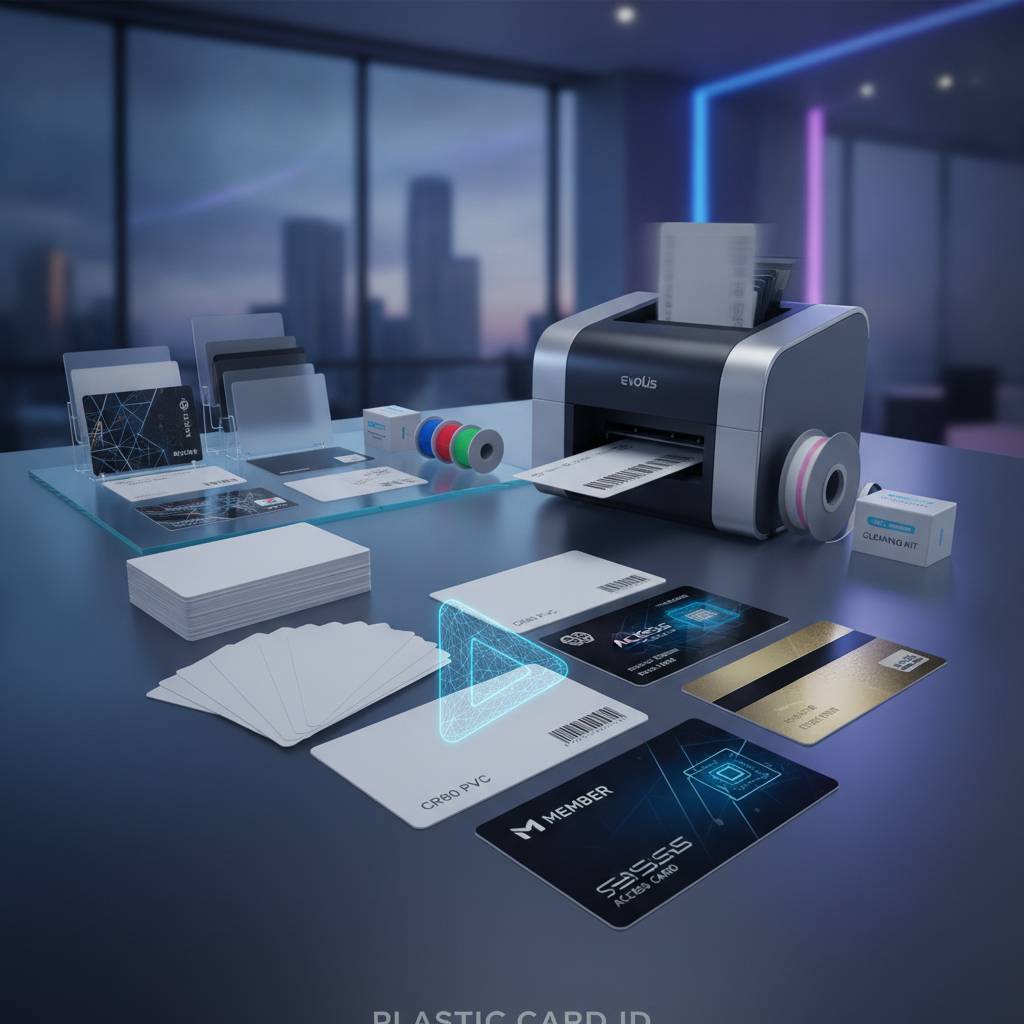
The Evolis Badgy200 is the flagship model in this category. It prints single-sided cards in full color at a cost-effective per-card rate, connects via USB, and includes straightforward design software. It's genuinely capable for organizations printing fewer than 1,000 cards per year - which covers a wider range of buyers than you might expect.
The Evolis Badgy200: Price and Performance
Retailing in the $300-$500 range, the Badgy200 is one of the most accessible professional card printers on the market. It handles standard CR80 PVC cards and produces output that looks far more polished than anything achievable with inkjet printing on paper cardstock. Setup is quick, the included software handles basic badge design, and replacement ribbons are widely available.
The trade-off is volume. Push a Badgy200 past its rated capacity and you'll wear it out prematurely. It's not built for daily bulk runs - but used within its design parameters, it's a reliable, affordable workhorse. For sub-1,000-card-per-year programs, it's often the smartest buy available.
What to Expect from Entry-Level Consumables
YMCKO full-color ribbons for entry-level printers typically yield 100 prints per ribbon and cost $30-$60 per ribbon, translating to roughly $0.30-$0.60 per card for color printing. Monochrome ribbons produce far more prints per ribbon at a significantly lower cost per card, making them attractive for badge programs that use color only on the card face and black text on the reverse.
Cleaning kits - essential for maintaining print quality and printer longevity - run $10-$25 for a basic cleaning set. Regular cleaning dramatically extends the life of any card printer, a fact that applies at every price tier but matters especially at the entry level where budgets are tighter.
Who Should Buy at This Price Point
Entry-level card printers are the right fit for small businesses, volunteer organizations, community organizations, and any operation where card printing is an occasional task rather than a regular workflow. If you're printing employee ID cards once a quarter for a team that rarely turns over, a $400 printer is a sound investment that will serve you for years.
Conversely, if your card program is expected to grow, plan ahead. It's easy to outgrow an entry-level machine, and CPE recommends factoring in your 12-18 month volume projection, not just today's numbers, when selecting a tier.
Mid-Range Card Printers: The $700-$2,000 Sweet Spot
This is where the majority of serious card printing programs live. Mid-range printers balance output quality, production speed, and feature availability at prices that make sense for organizations with genuine ongoing printing needs. Corporate HR departments, universities, healthcare facilities, and hospitality operations all typically find their answer somewhere in this bracket.
Evolis dominates this segment with the Zenius and Primacy2 models. Both deliver noticeably faster print speeds than entry-tier hardware, support duplex printing, and accommodate encoding upgrades for magnetic stripe and smart chip. The Primacy2 in particular has earned a strong reputation for reliability in demanding environments.
Evolis Zenius and Primacy2: What You Get
The Zenius, priced in the $700-$1,100 range depending on configuration, handles single-sided printing with high throughput and excellent image quality. It accepts optional encoding upgrades for magnetic stripe, making it flexible for access control or loyalty card programs. Print speed reaches approximately 200 cards per hour in full color - a meaningful upgrade over entry-level units.
The Primacy2 steps up further, with dual-sided printing standard on duplex configurations, faster throughput, and a more robust duty cycle suited to 1,000-6,000 cards per month. At $1,200-$1,800, it's a genuine production machine that most mid-size organizations won't outgrow quickly. The Primacy2 is frequently our most recommended model for corporate ID programs.
Fargo and Zebra in the Mid-Range
Fargo and Zebra bring strong options to this tier, particularly for organizations where security and credential integrity are priorities. Fargo printers are well known for lamination and holographic overlay capabilities that add visual and physical security layers to printed cards. Zebra hardware is valued for enterprise integration and robust fleet management features.
Both brands carry models in the $800-$1,800 range that compete directly with Evolis mid-range offerings. The choice between them often comes down to specific security features, software ecosystem preferences, or existing IT infrastructure. Call Plastic Card ID at 800.835.7919 to compare options side by side with guidance from an experienced specialist.
Consumables Costs at the Mid-Range Level
Mid-range printers typically use YMCKO ribbons yielding 200-300 prints per ribbon at costs of $50-$100 per ribbon, bringing per-card color printing costs down to $0.20-$0.40. Lamination film - available as an add-on module for several models in this tier - adds durability and a premium feel at an additional $0.10-$0.30 per card.
Cleaning kits for mid-range models remain similarly priced to entry-level kits, running $15-$30. Most mid-range printers come with a starter cleaning kit; factoring in quarterly cleaning maintenance keeps the machine operating at peak image quality and extends component life significantly.
Professional and Premium Card Printers: The $2,000-$5,000 Range
When edge-to-edge printing, maximum image fidelity, or serious encoding sophistication become requirements, the professional tier answers. These machines aren't for every buyer - but for the right application, they're transformative. Healthcare ID programs, government-issued credentials, and security access card systems demand output quality and reliability that lower-tier machines simply can't guarantee consistently.
The Evolis Agilia is the standout in this range. It delivers premium edge-to-edge printing with exceptional color accuracy, making it ideal for organizations where the card itself is a reflection of brand quality or institutional authority. The output is visibly superior to mid-range hardware, particularly on photo-quality ID cards.
The Evolis Agilia: Premium Output Justified
Priced in the $2,500-$4,000 range depending on configuration, the Agilia supports both single and dual-sided printing, accommodates magnetic stripe and smart chip encoding, and connects via both USB and ethernet for network-ready deployment. Its print engine is designed for consistent, high-volume output without degradation in quality over long runs.
Organizations that issue professional credentials - licensed healthcare workers, government employees, certified contractors - find the Agilia's output quality aligns with the seriousness of what the card represents. A credential that looks premium conveys authority; a blurry, washed-out card undermines the program entirely. The investment here is as much about institutional credibility as raw printing capability.
Security Features That Justify Higher Prices
At this tier, security encoding becomes more sophisticated. Multi-technology encoding - combining magnetic stripe with contactless RFID or smart chip on a single card - is achievable with the right printer configuration. Holographic laminate overlays, UV-fluorescent printing, and microtext security features are available on select models from Fargo and Zebra in this range as well.
These features aren't cosmetic. For facilities managing physical access control, secure data encoding on the card itself prevents duplication and unauthorized entry in ways that a visually printed card alone cannot. Security-grade card programs need security-grade printers, and the premium price reflects that functional requirement rather than mere branding.
Network and Fleet Considerations
Professional-tier printers typically support ethernet connectivity, enabling centralized network printing across multiple departments or locations. Fleet management software allows IT administrators to monitor ribbon levels, print counts, and maintenance status remotely - a meaningful operational advantage for large organizations managing multiple printers across a campus or facility.
Zebra printers in particular excel in enterprise fleet environments, with robust driver support and integration with major HR and access control software platforms. CPE often recommends this approach to large universities and healthcare networks managing ID programs at scale.
Industrial and High-Volume Systems: Above $5,000
At the top of the market, the focus shifts entirely from "can it print cards" to "how many cards can it print per hour without stopping." Industrial card printers are built for continuous operation, high-capacity input hoppers, automated output sorting, and the kind of throughput that makes on-site event badging or enterprise-scale card issuance operationally feasible.
The Matica Event Printer is a standout at this level, purpose-built for high-speed on-site badge printing at conferences, trade shows, and large-scale events. Printing hundreds of personalized badges per hour on demand is the specific problem this machine solves, and it does so with mechanical precision that makes the event experience seamless for both organizers and attendees.
The Matica Event Printer: Speed at Scale
Designed explicitly for event environments, the Matica Event Printer handles high-capacity continuous printing with minimal operator intervention. Large input hoppers hold hundreds of blank cards; output stackers organize finished badges without manual sorting. Print speeds at this tier can exceed 500 cards per hour under optimized conditions, making same-day large-batch runs genuinely practical.
For event producers managing registrant check-in at conferences of 500 to 5,000 attendees, the cost of an industrial printer is easily justified by the operational efficiency it delivers. Alternatives - pre-ordering from an outside vendor, manual on-site systems - introduce lead times, errors, and last-minute scrambles that industrial in-house printing eliminates.
Industrial Printers for Enterprise Card Programs
Beyond events, large enterprises - corporations with thousands of employees, major universities, hospital networks - sometimes require industrial production capability simply to manage ongoing card issuance at scale. Annual new-hire onboarding at a company with 500-plus employees per year generates significant printing demand, and mid-range printers often create bottlenecks in HR workflows.
Industrial systems from Zebra and Fargo at this tier support multi-feeder configurations, automated encoding at high speed, and integration with enterprise HR platforms. The investment is significant - $5,000-$15,000 or more depending on configuration - but for the right operation, the return in labor hours saved and program reliability is substantial.
Total Cost of Ownership at the Industrial Level
Industrial printers consume ribbons at high rates, making per-card consumable costs a critical budget line. Bulk ribbon purchasing, available through Plastic Card ID, reduces per-card costs meaningfully at volume. Cleaning and maintenance kits for industrial systems are more comprehensive than desktop equivalents, running $50-$150 per kit, and scheduled maintenance intervals are tighter.
Factor service agreements and parts availability into any industrial printer purchase decision. CPE recommends discussing the full total cost of ownership - hardware, consumables, maintenance - before committing to an industrial system. The upfront price is only part of the picture at this scale.
Buyer Tips: Getting the Right Printer at the Right Price from Plastic Card ID
After 25 years and more than 100,000 customers, we've seen every buying mistake in the book. The most common? Underbuying on volume capacity and overbuying on features that don't match the actual application. A smart card printer purchase starts with an honest assessment of your program's actual requirements - not what sounds impressive, but what you'll actually use every day.
The second most common mistake is ignoring ongoing consumable costs. A printer with a lower upfront price but a more expensive ribbon format can cost significantly more over three years than a slightly pricier unit with better ribbon economics. Always run the cost-per-card calculation before finalizing a choice.
Key Questions to Ask Before You Buy
- How many cards will you print per month? Be realistic - and project 18 months forward, not just today.
- Do your cards require dual-sided printing? If yes, only look at duplex-capable models from the start.
- Do you need magnetic stripe, smart chip, or RFID encoding? Confirm encoding requirements before selecting a model.
- Will you print in full color or primarily monochrome? Monochrome ribbon costs are dramatically lower - factor this in.
- Is network connectivity required? USB-only printers don't support shared or remote printing workflows.
- What's your consumables budget per year? Ribbons, cleaning kits, and laminate film add up - know your ongoing cost.
Getting clear answers to these questions before you call or browse narrows your options quickly and prevents post-purchase regret. The specialists at Plastic Card ID use exactly this framework to match buyers with the right hardware the first time.
Don't Overlook Accessories and Supplies
A card printer without a consistent supply of the right ribbons and cleaning materials is a printer that will underperform and wear out early. Plastic Card ID supplies the complete ecosystem: YMCKO full-color ribbons, monochrome ribbons, specialty overlay ribbons, cleaning kits, lamination modules, input hoppers for higher-volume production, and card carriers and sleeves for finished card storage and distribution.
Encoding upgrades are also available for many models - if your program's requirements evolve after purchase, adding magnetic stripe or smart chip capability as a factory upgrade module is often possible without replacing the entire printer. Planning for program growth at the time of purchase is smarter than replacing hardware later.
Applications We Support Every Day
The range of card programs we support spans virtually every industry vertical. Employee ID cards, student ID cards, membership cards for gyms and clubs, loyalty cards for retail programs, access control cards for secure facilities, hotel key cards, and event credentials for conferences and trade shows are all common applications our hardware supports daily.
Each application has slightly different requirements - hotel key cards need magnetic stripe encoding, event credentials need high-speed batch printing, student IDs often need dual-sided full-color output - and matching the hardware to the application is exactly where the Plastic Card ID team adds value. Reach out at 800.835.7919 to discuss your specific program with someone who has seen it before.
Ready to find the right printer at the right price for your card program? The team at Plastic Card ID is standing by to walk you through every option at every price point - no pressure, just expert guidance built on decades of real-world experience.
Call Plastic Card ID today at 800.835.7919 and get matched with the plastic card printer that fits your volume, your features, and your budget - the first time, every time.
Previous Page