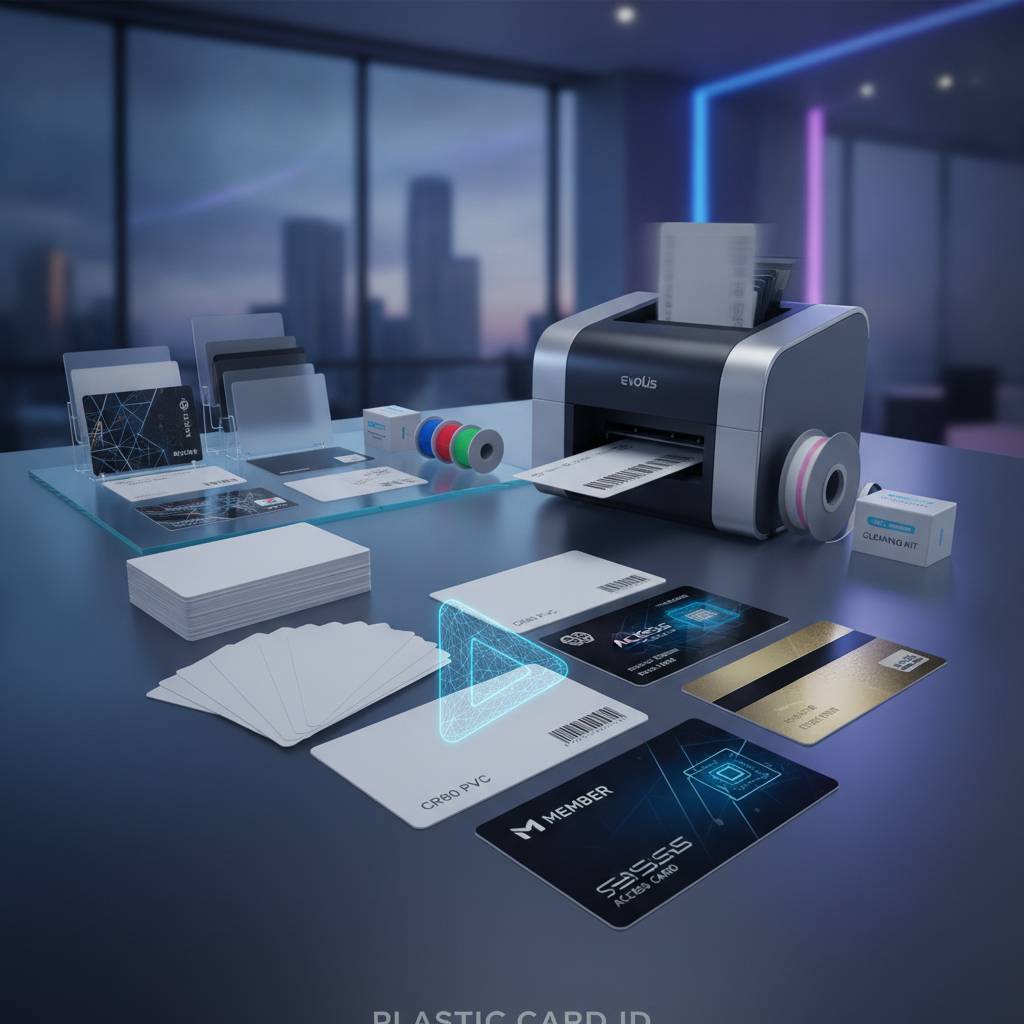
Magnetic Stripe Encoding on Card Printers: Full Overview
Table of Contents []
- Magnetic Stripe Encoding on Card Printers - Plastic Card ID
- What Magnetic Stripe Encoding Actually Does - And Why It Matters
- Card Printers With Magnetic Stripe Encoding: The Full Lineup
- Supplies and Accessories That Keep Your Encoding Program Running
- Buyer's Guide: Selecting the Right Magnetic Stripe Card Printer
- Applications That Depend on Magnetic Stripe Encoding
- Plastic Card ID - Your Trusted Source for Magnetic Stripe Card Printing
Magnetic Stripe Encoding on Card Printers - Plastic Card ID
Picture this: an employee walks up to a secure door, swipes their ID badge, and gains access in under a second. No fumbling with codes, no waiting for a guard to buzz them through. That seamless moment is powered by a tiny strip of magnetic material on the back of a plastic card - and the right card printer made it possible in-house, on demand, without outsourcing a single badge. That is exactly the kind of capability Plastic Card ID has been helping businesses unlock for over 25 years.
Magnetic stripe encoding is one of the most practical, widely adopted features available on professional card printers today. Whether you are issuing employee ID cards, hotel key cards, loyalty cards, or access control credentials, building that encoding capability directly into your printing workflow changes everything. You control the data. You control the timing. You control the cost.
| Card Program Type | Typical Volume | Recommended Printer | Encoding Option |
|---|---|---|---|
| Employee ID / Access Control | Under 1,000/year | Evolis Badgy200 | Magnetic Stripe Module |
| Hotel Key Cards / Loyalty | 1,000-6,000/month | Evolis Zenius / Primacy2 | HiCo / LoCo Magnetic Stripe |
| Student IDs / Campus Cards | Seasonal, high-burst | Fargo / Zebra Mid-Range | Magnetic Stripe Smart Chip |
| Event Credentials / Badges | High-speed on-site | Matica Event Printer | Magnetic Stripe Encoding |
| Membership / Rewards Cards | Variable, ongoing | Evolis Primacy2 / Agilia | Magnetic Stripe, 3-Track |
What Magnetic Stripe Encoding Actually Does - And Why It Matters
There is a surprising amount of confusion about what magnetic stripe encoding involves. Some buyers assume it is just a cosmetic feature - a dark stripe applied during printing. In reality, magnetic stripe encoding writes actual data onto the card during the print cycle, transforming a blank PVC card into a functional credential that readers and access systems can instantly interpret. That is a fundamentally different capability than printing alone.
The encoded data rides on one of three tracks along the stripe, each with different capacity and format standards. Track 1 holds alphanumeric characters and is commonly used for names and account identifiers. Track 2 is the workhorse track for numeric data, widely used in access control and hotel key systems. Track 3 offers additional numeric capacity for applications requiring more stored data. Many professional card printers can encode one, two, or all three tracks simultaneously.
HiCo vs. LoCo: Choosing the Right Coercivity
Not all magnetic stripes are created equal - and the distinction between high-coercivity (HiCo) and low-coercivity (LoCo) stripes matters more than most buyers initially realize. HiCo stripes require a stronger magnetic field to encode, which makes them far more resistant to accidental erasure from everyday magnets, wallet friction, or proximity to other cards. HiCo cards are the standard for employee ID cards, access credentials, and anything that needs to survive daily use over months or years.
LoCo cards encode more easily and are often used in applications where cards have a short lifespan - hotel key cards being the classic example. A hotel guest uses their room key for a few days and then discards it, so the easier-to-encode LoCo format is perfectly appropriate. Most professional card printers with magnetic stripe modules can handle both HiCo and LoCo encoding, often with a simple software or hardware setting change. Getting this right from the start saves significant frustration later.
The Three Tracks Explained
Each magnetic stripe track follows specific standards set by the ISO 7811 specification, and understanding those standards helps you configure your card program correctly from day one. Track 1 encodes at 210 bits per inch (bpi) and supports up to 79 alphanumeric characters - ideal for cardholder names, account numbers with letters, or other identifier formats that mix character types. Track 2 encodes at 75 bpi and holds up to 40 numeric characters, which is why it became the standard backbone of access control systems worldwide.
Track 3 is less commonly used in standard card programs but offers 107 numeric characters at 210 bpi, making it valuable for applications that need to store additional numeric data locally on the card itself. Understanding which tracks your access readers or loyalty system requires is a critical first step before selecting a printer or configuring an encoding module. CPE can walk you through the specifics for your exact use case.
Magnetic Stripe vs. Smart Chip: When to Use Which
Both magnetic stripe and smart chip encoding serve as credential technologies, but they do very different things. Magnetic stripe encoding stores fixed data that can be read quickly and easily by a swipe reader. Smart chip encoding, by contrast, stores data on a microprocessor that can perform cryptographic operations, update stored values, and resist cloning in ways that a magnetic stripe simply cannot. For many organizations, magnetic stripe encoding is entirely sufficient and dramatically simpler to implement.
That said, some card programs benefit from combining both technologies on a single card. A university campus card might use magnetic stripe for cafeteria swipes and building access while also carrying a smart chip for secure data transactions. Several printers in the Plastic Card ID lineup support both encoding types in a single pass, which is an enormous operational advantage when running a multi-function card program. The right configuration depends entirely on how your readers are set up and what your system demands.
Card Printers With Magnetic Stripe Encoding: The Full Lineup
Selecting a printer with magnetic stripe capability is not just about checking a box - it is about matching the encoder's specifications to your actual production environment, reader compatibility, and card volume. Plastic Card ID carries a carefully chosen range of printers from Evolis, Fargo, Zebra, and Matica, each with magnetic stripe encoding options that fit specific program types and budgets.
The Evolis family alone spans an impressive range - from the approachable Badgy200 for small organizations printing fewer than 1,000 cards per year, all the way to the Agilia for programs demanding edge-to-edge, premium-quality output at scale. Every step up in the product line brings increased throughput, more robust encoding hardware, and deeper integration options for enterprise card management software.
Evolis Printers With Magnetic Stripe Options
The Evolis Zenius and Primacy2 occupy the sweet spot for organizations printing between 1,000 and 6,000 cards per month. Both models support optional magnetic stripe encoding modules covering HiCo and LoCo configurations, and the Primacy2 in particular offers dual-sided printing in the same unit - a significant advantage for programs that need to print cardholder data on one side and barcode or magnetic stripe information formatted to back-of-card standards on the other.
The Evolis Agilia steps up the game with premium print quality and high-speed output for demanding programs. When your card program requires flawless imagery, precise color registration, and reliable magnetic stripe encoding at volume, the Agilia delivers without compromise. It is the kind of machine you buy once and run for years in a serious card issuance environment, not a starter unit.
Fargo and Zebra: Security-First Encoding
Fargo printers have long been a trusted choice for government agencies, law enforcement, and enterprise security programs - environments where card integrity and encoding reliability are non-negotiable. Fargo's encoding modules integrate directly into the print cycle, ensuring that each card's magnetic stripe data is written and verified before the card exits the unit. That verification step matters more than most buyers initially appreciate.
Zebra card printers bring their own legacy of rugged, high-reliability performance to magnetic stripe encoding, with a product line that suits everything from mid-volume ID programs to large-scale credential issuance. Both Fargo and Zebra units available through CPE support HiCo magnetic stripe as a standard or optional upgrade, making them straightforward to integrate into existing access control infrastructure.
Matica for High-Speed Event and On-Site Encoding
The Matica Event Printer occupies a unique niche - high-speed, on-site badge and credential printing where attendees may number in the thousands and every minute of throughput counts. Magnetic stripe encoding at event speed requires hardware that does not bottleneck the print cycle, and the Matica is specifically engineered to meet that challenge. It is a different machine for a different mission than an office desktop unit.
For event coordinators running conferences, trade shows, or venue access programs, the combination of fast printing and simultaneous magnetic stripe encoding means credentials are functional the instant they come off the machine - no separate encoding step, no secondary hardware, no workflow delay. That operational simplicity directly translates to shorter lines and smoother attendee experiences. Call Plastic Card ID at 800.835.7919 to discuss event printer configurations in detail.
Supplies and Accessories That Keep Your Encoding Program Running
A card printer with magnetic stripe capability is only as reliable as the supplies feeding it. Ribbons, cleaning kits, and properly specified blank cards all play a role in encoding accuracy and print quality. Running the wrong ribbon type or skipping routine cleaning cycles can introduce encoding errors that are frustratingly inconsistent - sometimes a card reads fine, other times it does not, and diagnosing the cause becomes a time-consuming puzzle.
Plastic Card ID stocks the complete range of consumables and accessories needed to support professional card programs. Ordering everything from a single source simplifies procurement and ensures compatibility across every component of your setup.
Ribbons: YMCKO, Monochrome, and Specialty Formats
The ribbon you choose affects both print quality and cost-per-card. YMCKO ribbons (yellow, magenta, cyan, black, and overlay) produce full-color card faces with a protective topcoat - the standard for ID cards, membership cards, and credentials that need to display photographs and color logos. Monochrome ribbons deliver sharp, single-color output at a fraction of the per-card cost, ideal for programs printing text, barcodes, or black-and-white designs at high volume.
Specialty ribbons including KO (black and overlay), silver, gold, and fluorescent options extend your design possibilities for loyalty cards, premium membership credentials, and event badges that need to stand out visually. Matching the right ribbon to your printer model is essential - a ribbon specified for an Evolis Primacy2 is not interchangeable with one designed for a Fargo or Zebra unit. CPE carries model-specific ribbons for every printer in the lineup.
Cleaning Kits: The Encoding Reliability Factor
Dust, card debris, and ribbon residue accumulate on print heads and encoding heads over time. Regular cleaning directly affects magnetic stripe encoding accuracy - a dirty encoding head can write data inconsistently, producing cards that fail intermittently on readers. This is one of the most overlooked maintenance factors in card programs that start experiencing mysterious read failures after months of reliable operation.
Cleaning kits for professional card printers typically include cleaning cards, cleaning swabs, and isopropyl-based cleaning solutions formulated specifically for the materials inside the printer. Most manufacturers specify cleaning intervals by card count - every 1,000 cards is a common benchmark, though high-dust environments may require more frequent attention. Building cleaning into your operational schedule protects both your printer investment and your encoding reliability.
Lamination Modules and Encoding Upgrades
For programs requiring maximum card durability, lamination modules add a protective film over the printed surface, dramatically extending card life in demanding use environments. Laminated cards resist scratching, UV fading, and surface wear - they look professional after months of daily handling in ways that unlaminated cards simply do not. Several Evolis and Fargo models support inline lamination modules that apply the overlay in a single integrated pass.
Encoding upgrades for magnetic stripe and smart chip can often be added to base printer models that were not originally ordered with those options. Input hoppers expand card capacity for high-volume production runs, reducing operator intervention. Card carriers and sleeves protect finished credentials during distribution and storage. Building out a complete card program with the right combination of hardware and accessories is straightforward when working with a supplier that stocks the full ecosystem.
Buyer's Guide: Selecting the Right Magnetic Stripe Card Printer
Shopping for a card printer with magnetic stripe encoding involves more variables than most buyers anticipate on first approach. Volume, coercivity, track configuration, reader compatibility, single-sided versus dual-sided printing, and budget all intersect in ways that can make the decision feel complicated. Breaking it down systematically makes the process far more manageable.
The most common mistake is buying for today's volume without considering growth. A printer that handles your current 500-card-per-year program comfortably may struggle or require replacement when that program grows to 3,000 cards per year within two years. Buying one step ahead of your current need almost always proves to be the smarter investment over a three-to-five year horizon.
Key Questions to Answer Before You Buy
- What coercivity does your reader system require? HiCo is the standard for most access control and ID programs; LoCo is typical for hotel key systems.
- Which tracks do you need to encode? Track 2 alone covers most access control applications; Track 1 and 3 add capacity for more complex data structures.
- What is your annual card volume? Low-volume programs under 1,000 cards per year have very different hardware needs than programs running 3,000-6,000 cards monthly.
- Do you need dual-sided printing? If cardholder information, photos, and barcodes need to appear on both faces of the card, your printer must support duplex output.
- What software is managing your card design and data? Compatibility between your card design software and the printer's driver is essential for seamless encoding integration.
- Is lamination required? High-wear environments benefit significantly from inline lamination; not all printers support this as an add-on module.
- What is your budget per card, not just upfront cost? Ribbon cost, cleaning supplies, and maintenance factor into total program cost over time.
Volume Tiers and Recommended Models
For organizations printing fewer than 1,000 cards per year - small businesses, nonprofits, or departments running a modest ID program - the Evolis Badgy200 with an optional magnetic stripe module offers an accessible entry point without overinvesting in capacity you will not use. It handles the essentials reliably and keeps upfront cost manageable. Starting right-sized is smarter than starting oversized for genuinely small programs.
Mid-range programs printing 1,000 to 6,000 cards per month should look seriously at the Evolis Zenius or Primacy2. Both deliver the throughput, encoding reliability, and print quality that growing programs require, with room to add lamination and dual-sided capability as needs evolve. Fargo and Zebra units in the same volume tier offer compelling alternatives for organizations already embedded in those ecosystems.
Understanding Total Cost of Ownership
The sticker price of a card printer is only one part of the actual investment. Ribbon cost per card, cleaning kit frequency, and the cost of blank PVC cards with the correct magnetic stripe specification all compound over the life of a program. A printer with lower upfront cost but higher ribbon prices can easily exceed the total cost of a higher-priced unit with more economical consumables over a two-to-three year run.
Request a cost-per-card breakdown before finalizing any purchase decision. Factor in the ribbon yield (how many cards per ribbon), cleaning kit frequency for your expected volume, and any encoding module costs that are separate from the base printer price. CPE is straightforward about these numbers because the goal is a card program that performs reliably for years - not a sale that leads to buyer's regret six months in.
Applications That Depend on Magnetic Stripe Encoding
The range of card programs that rely on magnetic stripe encoding is broader than most people expect. This technology is not limited to large enterprises or specialized industries - it is at work in hotels, universities, gyms, retailers, event venues, office buildings, and healthcare facilities every single day. Understanding where it fits helps clarify whether your own program needs it and how to configure it correctly.
Physical, in-house card printing with magnetic stripe encoding gives organizations total control over every credential they issue. Print on demand. Update data instantly. Reissue a lost card in minutes. Encode the exact tracks and data your system requires. The operational independence that comes with in-house printing is something organizations rarely give up once they have experienced it firsthand.
Employee ID and Access Control Cards
Employee ID cards with magnetic stripe encoding are among the most common applications for professional card printers. The card carries both a visual photo ID and an encoded credential that grants or restricts access to facilities, floors, parking areas, or equipment. When an employee is hired, transferred, or terminated, the card program administrator can issue or invalidate credentials immediately - no waiting for an outside vendor to produce and ship new cards.
Access control programs typically use HiCo encoding on Track 2, with a numeric identifier that maps to the employee's record in the access management system. The physical durability of HiCo stripes ensures daily swipe-and-go use does not degrade the card's function over months of service. The combination of visual identity and encoded access credential on a single card is both practical and professional.
Hotel Key Cards and Hospitality Programs
Hotel key cards are perhaps the most universally recognized application of magnetic stripe encoding. Every guest-facing key card in a property needs to be encoded at check-in with room access, elevator permissions, and stay duration - and re-encoded or voided at checkout. The entire hospitality experience depends on this working flawlessly at scale, across hundreds of rooms and thousands of guest cycles per year.
LoCo encoding is standard in most hotel property management systems, which means the magnetic stripe modules on Evolis, Fargo, and Zebra printers need to be correctly specified for LoCo output. Mismatched coercivity is one of the leading causes of key card failures in newly installed hotel card programs - a completely avoidable problem when the hardware is configured correctly from the start.
Loyalty, Membership, and Student ID Programs
Retailers and service businesses running loyalty or membership programs use magnetic stripe cards to link a physical credential to a customer's account in their POS or CRM system. The card itself stores a unique account number on the stripe; the reader passes that number to the software, which retrieves the customer's points balance, membership tier, and purchase history. It is a simple, reliable mechanism that has powered retail loyalty programs for decades.
Student ID programs at schools and universities often combine photo ID, library access, cafeteria swipes, and building entry on a single card - sometimes with magnetic stripe on one technology layer and smart chip on another. Managing this kind of multi-function credential in-house gives campus administrators the flexibility to reissue cards quickly, manage lost IDs efficiently, and update access rights without delays tied to external card vendors.
Plastic Card ID - Your Trusted Source for Magnetic Stripe Card Printing
Choosing the right card printer and encoding configuration is a decision with long-term consequences for your operations, your budget, and the people who depend on the credentials you issue every day. Plastic Card ID has spent over 25 years helping businesses across the United States get this decision right - not by pushing the most expensive option, but by matching each customer to the hardware and supplies that genuinely fit their program.
With over 100,000 customers served and a curated lineup of professional-grade printers from Evolis, Fargo, Zebra, and Matica, CPE brings deep product knowledge and real-world application experience to every conversation. Whether you are setting up your first card program or upgrading an existing one to add magnetic stripe encoding capability, the right guidance makes the process significantly less complicated.
Ready to get your magnetic stripe card printing program off the ground? Reach out to Plastic Card ID today at 800.835.7919 - the team is ready to help you find exactly the right printer, encoding configuration, and supplies to make your card program everything it needs to be.
Previous Page