ID Card Printer Plastic Cards: Features and Top Picks
Table of Contents []
- Why Plastic Card ID Is the Go-To Source for ID Card Printer Plastic Cards
- Understanding the ID Card Printer Landscape
- Plastic Card Printer Supplies: Keeping the Presses Running
- Buyer's Guide: Selecting the Right ID Card Printer
- Applications: What These Printers Actually Do in the Real World
- Frequently Asked Questions About ID Card Printer Plastic Cards
- Explore the Full Lineup with Plastic Card ID
Why Plastic Card ID Is the Go-To Source for ID Card Printer Plastic Cards
There's a moment every organization reaches - the realization that handing off card production to an outside vendor is costing more time, money, and control than it's worth. That's exactly where Plastic Card ID steps in. With more than 25 years in the business and a customer base exceeding 100,000 satisfied clients across the United States, CPE has built a reputation on delivering the right hardware, the right supplies, and the right guidance for businesses that take their ID card programs seriously.
This isn't a warehouse that ships whatever's available. It's a curated, professionally maintained lineup of plastic card printers and accessories from the industry's most trusted brands. Whether you're printing 200 employee badges a year or tens of thousands of event credentials per month, the answer lives somewhere in this catalog - and the team knows how to find it.
The Case for In-House Card Printing
Outsourcing sounds convenient until you factor in the lead times, the minimum order quantities, the inability to make last-minute changes, and the ongoing dependency on a third party for something as operationally critical as access control or employee identification. Printing in-house changes that equation entirely.
When you own the printer, you control the process. Need to onboard five new employees today? Print their cards today. Want to encode magnetic stripes for a new loyalty tier? Do it on the spot. Total on-demand card production is not a luxury - for many organizations, it's a competitive and operational necessity.
The upfront investment in a quality ID card printer pays for itself faster than most buyers expect. When you calculate cost-per-card at in-house production rates versus outsourced printing, the math is rarely close - and that's before accounting for turnaround time and the value of control.
Who Needs a Plastic Card Printer?
The applications are broader than most people initially assume. Schools print student IDs, staff badges, and library cards. Hotels encode room key cards on-site so they can be issued and voided instantly. Gyms and fitness clubs produce membership cards with barcodes or magnetic stripes for access tracking. Corporations print employee ID cards with photo identification and encoded access credentials.
Beyond those obvious use cases, the list keeps expanding. Event organizers print credentials at the door. Healthcare facilities issue patient and staff ID cards with embedded smart chips. Loyalty programs produce branded membership cards that reinforce customer relationships with a physical, durable touchpoint. If your organization issues any kind of card to any kind of person, you're already a candidate for in-house printing.
What Sets Plastic Card ID Apart
Longevity matters in this industry. Products evolve, technologies shift, and support needs arise - often long after the initial purchase. CPE has been navigating those changes for over two decades, which means their product recommendations come from experience, not just a brochure. The brands they carry aren't chosen at random; they represent the proven leaders in professional card printing technology.
Reach the team directly at 800.835.7919 to get matched with the right printer for your specific volume, encoding, and quality requirements. From first-time buyers to organizations replacing aging hardware, the process starts with a conversation.
Understanding the ID Card Printer Landscape
Walk into the world of plastic card printers without a map and you'll quickly feel overwhelmed. There are desktop units and industrial systems, single-sided and dual-sided models, retransfer and direct-to-card printing methods, and a dizzying array of ribbon types, encoding modules, and lamination options. Breaking it down by production volume and use case makes everything cleaner.
The four brands carried by Plastic Card ID - Evolis, Fargo, Zebra, and Matica - collectively cover every meaningful segment of the market. Each has distinct strengths, and the best choice for any given buyer depends on a handful of specific, answerable questions about their operation.
| Printer Model | Best For | Volume Range | Key Features |
|---|---|---|---|
| Evolis Badgy200 | Small organizations, low volume | Under 1,000 cards/year | Compact, easy setup, affordable |
| Evolis Zenius | Mid-range single-sided | 1,000-3,000 cards/month | Reliable, clean output, upgradeable |
| Evolis Primacy2 | Mid-range dual-sided | 3,000-6,000 cards/month | Dual-sided, mag stripe encoding |
| Evolis Agilia | Premium edge-to-edge output | High volume, top quality | Edge-to-edge, highest print quality |
| Fargo / Zebra Models | Security-focused ID programs | Variable | Robust, security features |
| Matica Event Printer | On-site event badging | High-speed burst printing | Fast throughput, event-ready |
Entry-Level Printers: Starting Smart
Not every organization needs an industrial powerhouse. For businesses, schools, or nonprofits printing fewer than 1,000 cards per year, an entry-level unit like the Evolis Badgy200 represents an intelligent, cost-effective starting point. These printers are compact, straightforward to set up, and produce clean, professional-looking plastic ID cards without requiring dedicated IT support or a specialized operator.
The cost of entry-level card printers typically ranges from $300-$700, putting professional card production within reach for organizations of virtually any size. Don't let the "entry-level" label mislead you - the output quality is professional-grade, and the simplicity of operation is genuinely a feature, not a limitation.
Mid-Range Workhorses: Where Most Buyers Land
The sweet spot for most organizations falls in the mid-range category. The Evolis Zenius and Primacy2 are the flagship examples - reliable, versatile, and built to handle the demands of continuous daily use without complaint. The Primacy2 in particular handles 3,000-6,000 cards per month with dual-sided printing capabilities and optional magnetic stripe encoding, making it one of the most capable mid-range units on the market.
Dual-sided printing is a game-changer for organizations that need to maximize the real estate on every card - think employee IDs with a photo and name on the front, plus a barcode, department information, or access level designation on the back. The Zenius and Primacy2 make that possible without sacrificing print speed or reliability.
High-Volume and Premium Systems
When volume is high, quality expectations are sky-high, or both simultaneously, the conversation shifts toward the Evolis Agilia and the industrial options from Fargo and Zebra. The Agilia delivers edge-to-edge printing at a caliber that makes every card look like it was produced by a commercial print shop - because, effectively, it was. Your print shop, your machine, your schedule.
Fargo and Zebra bring their own legacy of security and reliability to the table. Organizations running serious access control programs - government facilities, large corporate campuses, healthcare systems - often gravitate toward these brands for their robust build quality and the trust that comes from decades of deployment in high-stakes environments. Contact CPE at 800.835.7919 to discuss high-volume configurations.
Plastic Card Printer Supplies: Keeping the Presses Running
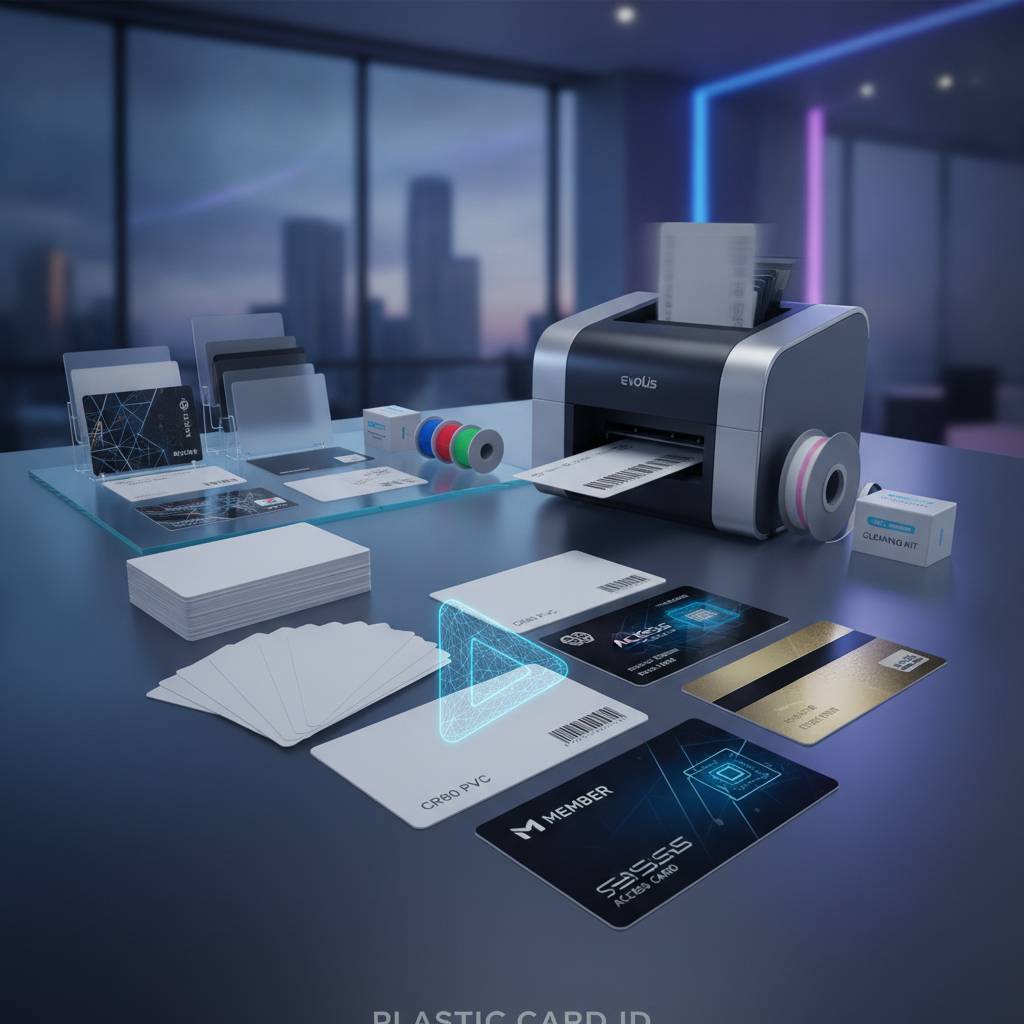
A printer without supplies is just an expensive paperweight. The operational side of card printing - ribbons, cleaning kits, lamination film, encoding modules - is where ongoing costs accumulate and where smart purchasing decisions really matter. Plastic Card ID supplies everything needed to maintain a card program from first print to thousandth, and every supply in the catalog is matched to the printers they sell.
Understanding which consumables your printer requires - and buying the right ones consistently - isn't just about print quality. It's about printer longevity. Using incorrect or low-quality ribbons degrades print heads faster, increases cleaning cycles, and ultimately shortens the life of equipment that should last years with proper care.
Printer Ribbons: Choosing the Right Type
The ribbon is arguably the most important consumable in any card printing operation. The three primary categories are YMCKO (full-color), monochrome, and specialty. YMCKO ribbons produce full-color output with a black resin panel and a clear overlay for protection - the standard choice for photo ID cards, membership cards, and any application requiring color printing.
Monochrome ribbons print in a single color - black, white, red, blue, gold, or silver - and are significantly more cost-efficient per card when full color isn't required. For loyalty cards with a simple barcode, or access cards with encoded data and minimal visible printing, monochrome is the economical and perfectly appropriate choice. Specialty ribbons handle unique requirements like metallic finishes or scratch-resistant overlays.
Cleaning Kits and Maintenance
Card printers are precision instruments. Dust, debris, and residue from cards and ribbons accumulate inside the machine during normal operation, and without regular cleaning, print quality degrades and mechanical issues arise. Cleaning kits - which typically include cleaning cards, swabs, and cleaning pens - are the routine maintenance equivalent of changing oil in a vehicle. Simple, inexpensive, and essential.
Most manufacturers specify a cleaning interval based on the number of cards printed. Following those intervals religiously is the single most impactful thing an operator can do to extend the life of their printer. Skipping cleanings is the number one cause of preventable printer failures in high-volume card programs.
Encoding, Lamination, and Accessories
Beyond the basics, the accessory ecosystem for ID card printers is rich and genuinely useful. Magnetic stripe encoding modules allow printers to write data to the stripe on the back of cards - enabling use cases like hotel key cards, loyalty programs, and access control systems. Smart chip encoding adds contact or contactless chip writing capability for more sophisticated credential programs.
Lamination modules add a protective film layer to finished cards, dramatically increasing durability and resistance to scratching, UV fading, and wear. Input hoppers expand the card capacity for high-volume runs, reducing the need for manual refilling. Card carriers and sleeves complete the package, offering a professional presentation for finished cards and protection during handling and distribution.
Buyer's Guide: Selecting the Right ID Card Printer
The decision matrix for selecting a plastic card printer comes down to five core factors. Get these right and the rest of the purchase practically selects itself. Rush the evaluation and you risk buying more printer than you need - or worse, not enough printer for the demands you'll place on it within the first year.
The right printer isn't necessarily the most expensive one - it's the one that fits your volume, your quality requirements, your encoding needs, and your budget without unnecessary overhead. Here's how to think through each factor systematically.
Factor 1: Annual Print Volume
Volume is the foundational variable. Estimate how many cards you'll print in a typical year - not just today's needs, but realistic projected growth over the next two to three years. Entry-level printers handle under 1,000 cards per year comfortably. Mid-range units like the Primacy2 manage 3,000-6,000 per month. Industrial systems handle substantially more without breaking a sweat.
Buying slightly more capacity than you currently need is almost always the smarter play. Upgrading a printer due to outgrown capacity is disruptive and ultimately more expensive than making the right call upfront. When in doubt, go one tier up.
Factor 2: Encoding Requirements
Will your cards need to do anything beyond display visual information? Magnetic stripe encoding is standard for access control, hotel keys, and loyalty programs. Smart chip encoding handles more sophisticated credential applications. If encoding is in scope now or even likely in the future, verify that your printer model supports it - either natively or through an available upgrade module.
- Magnetic stripe encoding: standard access control, hotel key cards, loyalty programs
- Contact smart chip encoding: secure credentials, healthcare ID applications
- Contactless smart chip (RFID): hands-free access control, modern ID programs
- Barcode printing: entry-level tracking, event credentials, library cards
- No encoding needed: basic photo IDs, membership cards with visual-only verification
Factor 3: Print Quality and Card Type
Not all print applications demand the same quality threshold. A basic employee ID with a photo and name looks professional at standard YMCKO output. But a premium loyalty card, a VIP event credential, or a branded membership card may warrant the edge-to-edge, highest-quality output of a system like the Evolis Agilia. Match your quality expectations to your brand standards and the impression you want the card to make in the recipient's hand.
Card material also plays a role. Standard PVC cards are the default for most applications - durable, professional, and compatible with virtually all card printers. Composite cards and other specialty substrates may require specific printer configurations. The team at CPE can walk through compatibility before you commit to a purchase.
Applications: What These Printers Actually Do in the Real World
Theory is useful; reality is more convincing. The plastic card printers in the Plastic Card ID catalog are actively deployed across virtually every industry sector in the United States, solving real operational problems for organizations that couldn't or didn't want to rely on outside card vendors anymore.
The range of use cases is legitimately broad. If you've ever swiped a key card to enter an office, scanned a gym membership card, or received a plastic student ID from a school, there's a strong chance a printer not unlike the ones in this catalog produced it.
Corporate and Enterprise ID Programs
Large corporations with distributed workforces face a constant, ongoing need for employee ID cards. New hires, terminated employees, role changes, site relocations - the card lifecycle is continuous. In-house printing gives HR and security teams the ability to issue and revoke credentials instantly, without waiting days for an outside vendor to process and ship a card that's needed today.
Security and speed are equally critical in enterprise settings. Encoded access cards that grant entry to specific facilities or floors need to be precise, properly programmed, and immediately available. The combination of a reliable mid-range or enterprise printer and a clean encoding workflow delivers exactly that.
Education and Healthcare
Schools and universities issue thousands of ID cards per semester - student IDs, faculty badges, library access cards, and athletic credentials. The volume and frequency of issuance makes in-house printing not just convenient but genuinely necessary. A mid-range card printer pays for itself in the first semester when you factor in the cost of outsourced production at that volume.
Healthcare presents its own distinct requirements. Patient ID bands aside, hospital and clinic staff need secure, photo ID credentials with clear role designation. Visitor management programs often issue temporary credentials. Smart chip encoding for access to restricted areas adds another layer to the card's function. Healthcare ID programs are among the most demanding real-world applications for plastic card printing technology, and the hardware in this lineup is built to meet those demands.
Events, Hospitality, and Retail
The Matica Event Printer earns its place in the catalog by solving a specific, high-pressure problem: printing large numbers of credentials quickly, on-site, at events where waiting is not an option. Conferences, trade shows, sports events, festivals - any scenario where badge production at the door is the model benefits from the Matica's high-speed throughput.
Hotels encoding room key cards in-house eliminate the cost and lag of pre-ordering from an outside supplier and gain the ability to handle exceptions instantly. Retail loyalty programs producing branded membership cards at the point-of-sale create a memorable, tangible brand touchpoint. Every card that leaves your printer is a physical representation of your brand - and it should look like one.
Frequently Asked Questions About ID Card Printer Plastic Cards
Buyers at every stage of the process tend to have similar questions. Here are the ones that come up most consistently, answered directly and without the runaround.
What's the Total Cost of Ownership for a Card Printer?
The purchase price of the printer is just the beginning. Ribbons, cleaning kits, blank PVC cards, and any encoding supplies all factor into ongoing operational costs. A typical full-color ribbon cartridge for a mid-range printer produces 200-300 cards and costs $30-$80, putting per-card costs in a highly competitive range compared to outsourced production.
Over three to five years, a mid-range printer purchased for $800-$1,500 paired with normal consumable costs typically delivers a significantly lower total cost per card than any outsourced alternative. The math consistently favors in-house printing once volume passes even a modest threshold. Contact CPE at 800.835.7919 for a customized cost comparison based on your actual anticipated volume.
Can I Upgrade a Printer Later?
Many of the printers in the Plastic Card ID lineup - particularly Evolis models - are designed with modularity in mind. Magnetic stripe encoding, lamination modules, and expanded input hoppers are available as factory or field-installable upgrades on select models. This makes the Zenius and Primacy2 particularly smart investments for organizations whose needs are expected to grow.
Not every upgrade is available on every model, and some encoding configurations require specific printer SKUs rather than field upgrades. Clarifying upgrade paths before purchase prevents the frustration of discovering a desired feature isn't retrofittable. The team at CPE can map out exactly which upgrades are available for any given model before you commit.
How Long Do Card Printers Last?
With proper maintenance - regular cleaning intervals, genuine manufacturer-approved ribbons, and reasonable operating conditions - a quality card printer from Evolis, Fargo, Zebra, or Matica should deliver years of reliable service. Many organizations report five to ten years of productive use from well-maintained mid-range units.
Maintenance is the single biggest determinant of printer lifespan. Organizations that clean on schedule, use the right ribbons, and store cards and supplies properly consistently get the most out of their equipment. Skipping maintenance cycles is, without exception, the fastest way to shorten a printer's useful life.
Explore the Full Lineup with Plastic Card ID
The combination of 25-plus years of industry experience, a carefully curated hardware lineup from Evolis, Fargo, Zebra, and Matica, and a complete supply catalog covering everything from YMCKO ribbons to lamination modules positions Plastic Card ID as a genuinely complete solution for organizations at every stage of their ID card printing journey.
Whether you're buying your first printer, upgrading aging hardware, or scaling a card program to meet growing organizational demand, the right equipment is here, the supplies to run it are here, and the expertise to help you make a confident decision is here too. Serious card programs deserve serious hardware - and that's precisely what this catalog delivers.
Getting Started Is Straightforward
The process of selecting and purchasing a plastic card printer doesn't have to be complicated. Know your approximate annual volume, identify whether encoding is required, and have a general sense of your per-card quality expectations. Bring those three pieces of information to a conversation with CPE, and the right recommendation follows naturally.
From compact desktop units for small organizations to high-throughput industrial systems for enterprise card programs, every tier is represented in a lineup that has been refined over 25 years of real-world customer feedback and product evolution. The catalog exists because every type of buyer has distinct needs - and one size genuinely does not fit all in professional card printing.
Ready to Take Control of Your Card Program?
Contact Plastic Card ID today and speak with a knowledgeable team member who can match you with the right ID card printer plastic cards solution for your specific needs. Call 800.835.7919 now and take the first step toward complete control of your card production program.
From entry-level desktop printers to high-volume industrial systems, and every ribbon, cleaning kit, and encoding module in between, Plastic Card ID has everything your organization needs to print professional plastic ID cards in-house - on your schedule, on your terms. Call 800.835.7919 today.
Previous Page