Best Plastic Card Printer: Top-Rated Models Compared
Table of Contents []
- Why Plastic Card ID Is the Trusted Source for the Best Plastic Card Printer
- The Full Lineup: Finding Your Best Plastic Card Printer Match
- Consumables and Accessories That Keep Your Program Running
- The Real Case for In-House Card Printing
- Buyer's Guide: How to Choose the Best Plastic Card Printer for Your Needs
- Applications Across Industries: What Organizations Are Printing
- Partner With Plastic Card ID for Your Best Plastic Card Printer Solution
Why Plastic Card ID Is the Trusted Source for the Best Plastic Card Printer
Choosing the right card printer isn't a minor purchasing decision - it shapes how your organization presents itself every single day. Whether you're producing employee badges, access control cards, or loyalty credentials, the equipment you use determines print quality, operational efficiency, and long-term cost control. That's a lot riding on one piece of hardware.
Plastic Card ID has spent more than 25 years placing professional-grade card printing systems into businesses across the United States. With over 100,000 customers served and a curated lineup featuring industry-leading brands like Evolis, Fargo, Zebra, and Matica, CPE knows what separates a smart investment from an expensive regret. This page breaks down everything you need to make that call with confidence.
The card printer market is crowded with options that range from impressive to misleading. Not every machine sold as "professional" delivers consistent, sharp, durable output. Not every supplier understands the difference between printing 200 cards a year and 5,000 cards a month. Plastic Card ID does - and that expertise has made them the go-to resource for organizations that need results, not guesswork.
A Quarter Century of Card Printing Expertise
Longevity in any industry reflects something real. When a supplier has been serving card printing customers since the late 1990s, they've navigated every shift in technology, every change in ribbon chemistry, and every evolution in encoding standards. That accumulated knowledge is available to every customer who contacts CPE.
More than a storefront, Plastic Card ID functions as a knowledgeable partner. Their team helps match customers to the right printer for their volume, application, and budget - preventing costly mismatches before they happen. That's the difference between a vendor and a specialist.
What "Best Plastic Card Printer" Actually Means
The best printer isn't necessarily the most expensive one. It's the one that aligns with your specific output requirements, card application, and operational environment. A small membership organization printing 400 cards per year has completely different needs than a university managing thousands of student IDs each semester.
Volume, print quality, encoding needs, single versus dual-sided printing, and long-term consumable costs all factor into the equation. Plastic Card ID helps customers evaluate each of these dimensions honestly - because the right fit delivers years of reliable service, while the wrong one creates frustration and unexpected expenses.
Serving Every Industry That Needs Professional Cards
The applications are broader than most people initially realize. Plastic card printers support employee ID programs, building access control, membership management, student identification, hotel key card issuance, event credentialing, loyalty programs, and more. Each use case carries its own set of performance requirements.
Organizations that have worked with CPE include healthcare facilities managing staff badges, fitness centers issuing membership cards, corporations running secure access programs, schools producing student IDs, and hotels printing key cards on demand. The common thread is a need for professional output, operational control, and reliable hardware - exactly what this lineup delivers.
| Printer Model | Brand | Volume Range | Best For | Encoding Options |
|---|---|---|---|---|
| Badgy200 | Evolis | Under 1,000/year | Small orgs, clubs, low-volume ID | Basic |
| Zenius | Evolis | 1,000-3,000/month | Mid-size businesses, access control | Mag stripe, smart chip |
| Primacy2 | Evolis | Up to 6,000/month | Enterprises, universities, hospitals | Mag stripe, smart chip, dual-side |
| Agilia | Evolis | High volume, premium output | Edge-to-edge premium ID programs | Full encoding suite |
| Fargo / Zebra Models | Fargo / Zebra | Mid to high volume | Security-focused ID programs | Full security encoding |
| Matica Event Printer | Matica | High-speed on-site | Events, conferences, registrations | Event badge encoding |
The Full Lineup: Finding Your Best Plastic Card Printer Match
Every organization arrives at the card printing conversation from a different starting point. Some already know they need dual-sided printing with magnetic stripe encoding. Others are simply replacing an aging unit and want to know what's improved. And some are launching a card program from scratch, with no frame of reference at all. Plastic Card ID covers all of it.
The lineup spans entry-level desktop units designed for simplicity and economy all the way to industrial-grade systems built for demanding, continuous-output environments. What connects every model in the catalog is a commitment to professional-grade print quality and proven reliability. There are no consumer-grade machines dressed up in business packaging here.
Entry-Level Printing: Evolis Badgy200
For organizations printing fewer than 1,000 cards per year, the Evolis Badgy200 is a genuinely capable starting point. It handles full-color card printing without demanding extensive technical knowledge, making it accessible for small businesses, nonprofits, community organizations, and membership clubs that need real ID cards without complexity.
The Badgy200 is compact, straightforward to set up, and produces results that look polished and professional. At its volume tier, cost per card remains manageable, and the overall investment in hardware stays modest. For organizations just beginning their in-house card printing journey, it's a logical entry point that doesn't lock them into unnecessary overhead.
Mid-Range Workhorses: Evolis Zenius and Primacy2
Step up to the Zenius and Primacy2, and you're operating in different territory entirely. These machines are built for organizations printing 1,000 to 6,000 cards per month - and they're engineered to do it consistently, shift after shift, without complaint. Both models support dual-sided printing and can be configured with magnetic stripe encoding and smart chip encoding options.
The Primacy2 in particular has earned a strong reputation in higher-volume environments like universities, corporate campuses, and healthcare facilities. Its throughput capacity, image consistency, and encoding versatility make it one of the most well-rounded mid-range card printers available. Contact CPE at 800.835.7919 to discuss which configuration suits your volume and encoding requirements.
Premium Output: The Evolis Agilia
When output quality is the non-negotiable priority - edge-to-edge printing, precise color reproduction, cards that make an impression every time they're seen - the Evolis Agilia steps in. This is the machine for organizations where the card itself is part of the brand experience. Loyalty programs for premium brands, corporate ID programs with exacting standards, and institutions where the card reflects organizational reputation all benefit from the Agilia's performance ceiling.
It's not the right tool for every budget or every volume tier. But for those who need the absolute best in plastic card output, the Agilia delivers results that justify the investment. Plastic Card ID can help you evaluate whether this model aligns with your program requirements and long-term printing goals.
Security and Speed: Fargo, Zebra, and Matica
Fargo and Zebra printers occupy an important space in security-focused ID programs. These brands are well established in government, law enforcement, corporate security, and institutional environments where card integrity and data encoding carry real stakes. Their feature sets around holographic overlays, security printing elements, and encoding robustness make them strong choices when the ID program demands more than aesthetics.
The Matica Event Printer solves a very specific and often urgent problem: high-speed badge printing directly on-site at events. Conferences, trade shows, training events, and large corporate gatherings often require rapid badge production for hundreds or thousands of attendees. The Matica handles that workload without creating a bottleneck at registration.
Consumables and Accessories That Keep Your Program Running
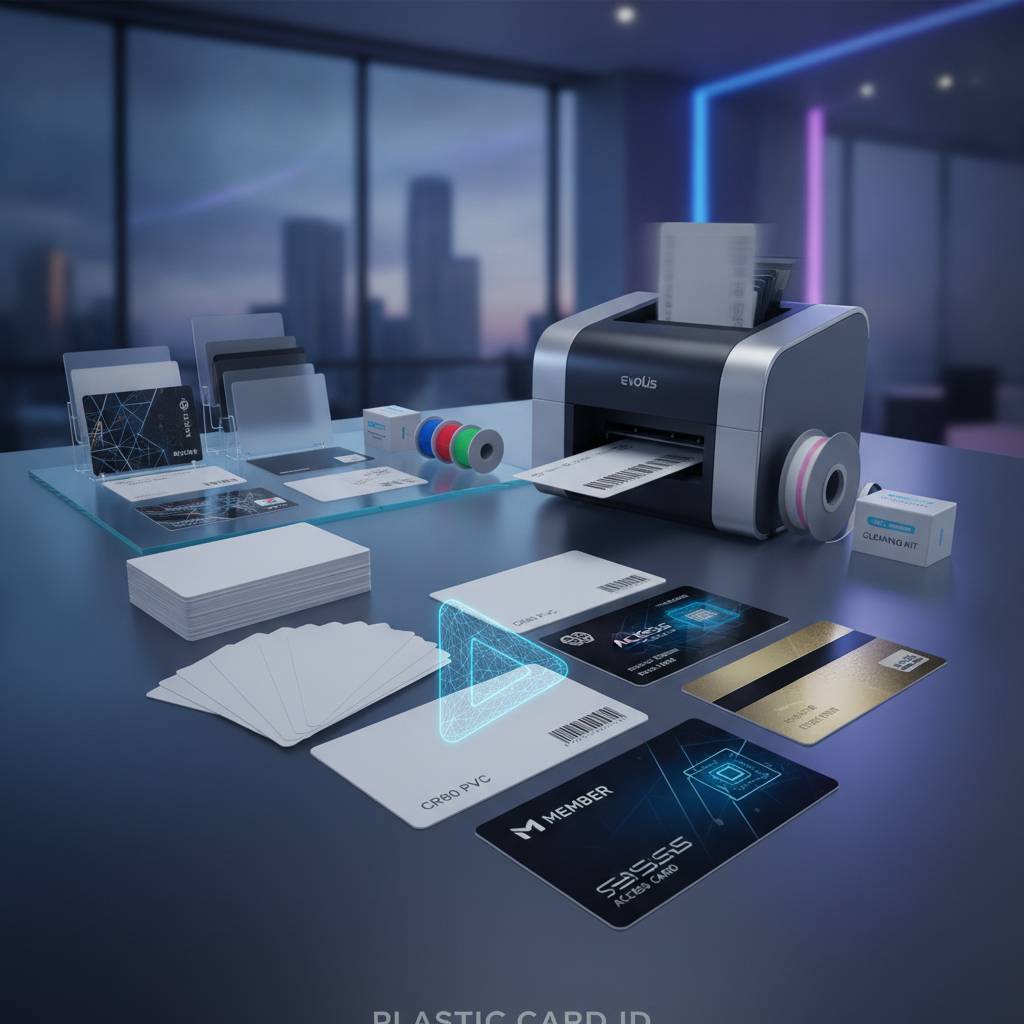
A card printer without the right consumables is just hardware sitting on a shelf. The ongoing operational side of any card program depends on having the correct ribbons, cleaning supplies, and optional modules on hand - and on sourcing them reliably. Plastic Card ID supplies the full range of consumables for every printer in their lineup.
This matters more than it might initially seem. Using incorrect ribbons can degrade print quality, damage print heads, and void warranties. Skipping cleaning cycles allows debris and residue to accumulate, shortening the life of expensive components. Running a card program properly means treating consumables as a core operational input, not an afterthought.
Printer Ribbons: YMCKO, Monochrome, and Specialty
YMCKO ribbons - yellow, magenta, cyan, black, and overlay - are the standard for full-color card printing. They deliver the vivid, multi-tone output that most professional ID programs require. Monochrome ribbons serve applications where single-color output suffices, typically at a lower cost per card. Specialty ribbons address specific requirements like holographic lamination panels or security overlays.
Matching the correct ribbon to the application is essential. A YMCKO ribbon used for a simple text-only badge wastes capacity and drives up cost per card unnecessarily. Conversely, using a monochrome ribbon where full-color output is expected produces inadequate results. CPE helps customers identify the optimal ribbon configuration for their specific printing profile.
Cleaning Kits and Maintenance Supplies
Print head longevity is directly tied to cleaning discipline. Most professional card printers incorporate automated cleaning cycles that use cleaning cards - simple to use, easy to overlook when the printer appears to be running fine. Regular maintenance prevents the gradual quality degradation that accumulates when cleaning is deferred.
Cleaning kits from Plastic Card ID are matched to specific printer models and designed to remove the card dust, ribbon residue, and contaminants that accumulate during normal operation. Protecting a significant hardware investment through consistent maintenance is straightforward - and far less expensive than replacing a print head prematurely.
Lamination Modules, Encoding Upgrades, and Card Carriers
Lamination modules add a protective overlay to printed cards, dramatically extending durability and providing an additional layer of visual security. For cards that experience heavy daily use - employee badges scanned multiple times per day, membership cards carried in wallets, hotel key cards subjected to repeated insertion and removal - lamination extends functional card life considerably.
Encoding upgrades for magnetic stripe and smart chip expand what a card can do beyond its visual identity. A card with a functioning magnetic stripe or embedded chip becomes an active tool for access control, time and attendance systems, cashless payment integration, and more. Input hoppers increase batch printing capacity, while card carriers and sleeves provide professional presentation and physical protection for completed cards. Plastic Card ID supplies all of these components to support a complete, fully equipped card program.
The Real Case for In-House Card Printing
Organizations that have made the transition from outsourcing their card production to printing in-house consistently describe the same core experience: more control, faster turnaround, and a clearer view of what their cards actually cost. The decision to bring card printing internal is rarely reversed once the operational benefits become apparent.
The appeal of outsourcing - no equipment to manage, no consumables to stock - tends to erode quickly when you factor in lead times, minimum order quantities, per-card pricing at low volumes, and the inability to make last-minute adjustments. In-house printing answers all of those friction points simultaneously.
Print on Demand, Personalize Every Card
The most immediate benefit is demand-driven production. When a new employee starts on a Tuesday, their ID badge can be printed Tuesday morning. When a member joins mid-month, their card is ready the same day. There's no waiting for batch production cycles, no minimum order quantities, and no dependence on an outside vendor's production schedule.
Personalization is equally immediate. Each card can carry the individual's photo, name, title, department, and encoded data - all produced in a single pass through the printer. For organizations managing diverse card populations with variable information, that capability is transformative. Every card is accurate, current, and produced exactly when it's needed.
Encoding Capabilities That Activate Your Cards
A printed card is a visual credential. An encoded card is an active tool. Magnetic stripe encoding stores data that access control readers, POS systems, and loyalty platforms can read and process. Smart chip encoding goes further, supporting higher-capacity data storage and more sophisticated security protocols.
Organizations running access control systems, cashless payment programs, or loyalty platforms that interact with card-based credentials need encoding built into their printing workflow. Plastic Card ID configures printers with the encoding options that match each customer's downstream systems - ensuring that the card leaving the printer is immediately functional in its intended environment.
Eliminating Lead Times and Vendor Dependency
- No minimum order requirements - print one card or one hundred, based on actual need
- Same-day card issuance - new hires, new members, replacement cards produced immediately
- Complete design control - update templates, branding, or data fields without reordering from a vendor
- Predictable per-card costs - ribbon yield and card stock pricing are known quantities, not variable vendor invoices
- Encoding flexibility - change magnetic stripe data formats or chip configurations as systems evolve
- No shipping delays - cards don't wait in a production queue or a shipping container
The aggregate value of these advantages compounds over time. Organizations that commit to in-house printing typically find that the hardware pays for itself well within the first year of operation - often within the first few months, depending on previous outsourcing costs and card volume.
Buyer's Guide: How to Choose the Best Plastic Card Printer for Your Needs
The decision matrix for selecting a card printer is more nuanced than it first appears. Price point is an obvious consideration, but it's rarely the most important one. A printer that costs $400 less upfront but requires a ribbon that costs 40% more per card will almost certainly cost more over a three-year operating horizon. The real comparison is total cost of ownership.
Volume, encoding requirements, single versus dual-sided output, lamination needs, and the nature of the card application all need to be evaluated before settling on a model. CPE provides guidance through this process for every customer - ensuring that the printer purchased is the printer that actually fits the program.
Matching Volume to Hardware Capability
Under-specifying a printer for actual volume needs leads to accelerated wear, more frequent maintenance, and shortened hardware lifespan. Over-specifying means paying for throughput capacity that never gets used. The goal is an accurate match between what the printer is rated to handle and what the program actually demands.
As a working framework: under 1,000 cards per year points toward the Badgy200 tier. Between 1,000 and 6,000 cards per month places you firmly in Zenius or Primacy2 territory. Higher volume, premium-output, or security-intensive programs call for Agilia, Fargo, or Zebra consideration. The Matica Event Printer occupies its own category for on-site event credentialing specifically.
Single-Sided vs. Dual-Sided Printing
Single-sided printers are sufficient when all card content fits on one face - a common scenario for simple ID badges or basic membership cards. Dual-sided models open up the back of the card for additional information: barcodes, instructions, policy text, secondary branding, or encoding indicator markings.
Many organizations start with single-sided printing and later discover they need the back of the card for functional content. Selecting a dual-sided capable model from the outset - or choosing a printer with a dual-sided upgrade path - prevents the need to replace hardware prematurely. Plastic Card ID helps customers think through this decision before the purchase, not after.
Questions to Ask Before You Buy
- How many cards will you print per month, on average?
- Do your cards need magnetic stripe encoding, smart chip encoding, or both?
- Is dual-sided printing a current or likely future requirement?
- Will cards need lamination for durability or security?
- What downstream systems will the cards interact with (access control, loyalty platform, POS)?
- Is batch printing capacity (input hopper) important for your workflow?
- What is your realistic budget for both hardware and ongoing consumables?
Walking through these questions before contacting CPE will make the selection conversation faster and more productive. The more precisely your requirements are defined, the more accurately the right printer model can be identified.
Applications Across Industries: What Organizations Are Printing
The range of applications for in-house plastic card printing is genuinely broad. It's not just corporate employee badges, though that remains one of the most common use cases. The same hardware that prints an employee ID can produce a hotel key card, a university student credential, a fitness center membership card, or a conference badge - with appropriate configuration for each application.
Understanding what's possible often opens up new applications that organizations hadn't initially considered. A business that purchases a card printer for employee IDs may quickly realize the same equipment can support a customer loyalty program, a visitor management program, or an access control rollout.
Employee ID and Access Control Programs
Corporate employee ID programs are among the most consistent and widespread applications for in-house card printing. Organizations of any size benefit from producing photo ID badges that reflect current staff, current branding, and current access permissions. When employees join, transfer, or depart, card management is handled immediately without vendor dependency.
Access control integration takes this further. Cards encoded with magnetic stripe or smart chip data interact directly with door readers, elevator systems, parking gates, and time-and-attendance platforms. A well-configured in-house card printing program can serve as the operational backbone of an entire physical security infrastructure. Contact CPE at 800.835.7919 to discuss encoding configurations for access control applications.
Membership, Loyalty, and Student ID Programs
Membership organizations - fitness centers, associations, libraries, clubs - rely on cards to identify members, facilitate service access, and reinforce brand recognition. Loyalty programs use cards to track customer engagement and reward behaviors. Student ID programs serve identification, library access, meal plan management, and campus services simultaneously.
What these applications share is a recurring need to issue new cards as membership grows and to replace damaged or lost credentials quickly. In-house printing handles both requirements naturally. New members get their card the day they join, not the week after. Replacement cards are produced in minutes, not ordered and waited for.
Event Credentials and Hotel Key Cards
Event credentialing is a specialized application where speed is paramount. Conference attendees, trade show participants, and corporate event guests need badges quickly at registration - delays create poor first impressions and crowd management problems. The Matica Event Printer addresses this directly, providing the throughput needed to keep registration lines moving during peak check-in periods.
Hotel key card programs benefit from in-house printing for different reasons. Hotels need to issue key cards continuously throughout the day, often encoding specific room access and stay duration data in real time. Having the printer and encoding capability on property means a guest checking in at 2 AM gets their key card without any operational friction. The card program becomes invisible to the guest - which is exactly how it should work.
Partner With Plastic Card ID for Your Best Plastic Card Printer Solution
After more than 25 years and over 100,000 customers served, Plastic Card ID understands that buying a card printer is only the beginning of the relationship. The consumables need to flow reliably. The hardware needs to perform consistently. And when questions arise - about ribbon selection, cleaning procedures, encoding configurations, or upgrade options - customers need access to people who actually know card printing.
That depth of support is built into every customer relationship CPE establishes. It's not about selling a single transaction. It's about ensuring that the card program works, month after month, and that the organization running it has a knowledgeable resource available when they need one. That's a different kind of supplier relationship - and it's what 25 years of focused expertise makes possible.
Everything You Need, All in One Place
Printer hardware, YMCKO and monochrome ribbons, specialty ribbons, cleaning kits, lamination modules, encoding upgrades, input hoppers, card carriers, and card sleeves - the complete supply chain for a professional card program lives in one catalog. There's no need to juggle multiple vendors for different components or reconcile compatibility issues across sources.
That consolidation simplifies operations, ensures compatibility, and builds in the institutional knowledge that comes from a supplier who knows every product in the lineup. When Plastic Card ID recommends a ribbon or a cleaning kit, it's because they know it's the right match for the specific printer and application - not because it's what happened to be in stock.
Straightforward Pricing, No Surprises
Professional card printing hardware spans a meaningful price range depending on capability, volume rating, and encoding configuration. Entry-level units sit at the lower end of that range; high-throughput industrial systems with full encoding suites represent a significantly larger investment. What doesn't change across that range is transparent pricing and honest guidance about what each tier of hardware actually delivers.
CPE doesn't push customers toward the most expensive option in the lineup. The goal is matching the customer to the right solution - because a customer running a well-matched card program becomes a long-term partner, not a one-time buyer with buyer's remorse. Good advice is the best sales strategy, and it's how Plastic Card ID has maintained customer relationships across decades.
Ready to Find Your Best Plastic Card Printer?
Whether you're launching a new card program, replacing aging hardware, or scaling up to meet growing volume demands, the conversation starts with understanding what you actually need. Plastic Card ID is ready to have that conversation - with zero pressure and maximum expertise applied to your specific situation.
Reach out directly to speak with a card printing specialist who can help you navigate the lineup, compare options, and select the configuration that fits your organization's requirements and budget. The right printer is the one that serves your program well for years - and finding it starts with one call.
Contact Plastic Card ID today at 800.835.7919 - your trusted source for the best plastic card printer, consumables, and expert guidance. Let Plastic Card ID put 25 years of experience to work for your card program.
Previous Page