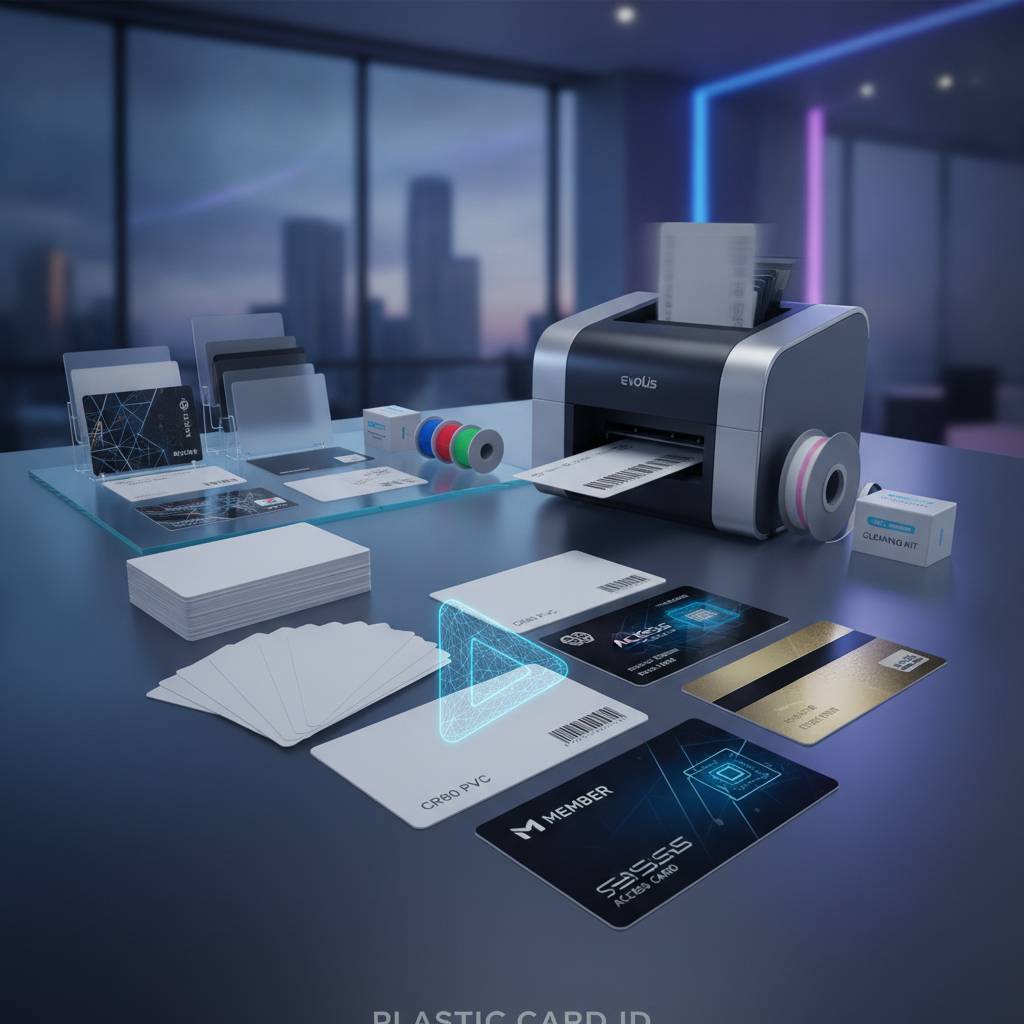
In-House Plastic Card Printer: Save Time and Cut Costs
Table of Contents []
- Why Plastic Card ID Is the Go-To Source for Your In-House Plastic Card Printer
- The Real Case for Bringing Card Printing In-House
- Choosing the Right Printer for Your Volume and Use Case
- Security-Focused ID Printing: Fargo and Zebra Options
- Ribbons, Supplies, and Everything That Keeps Your Printer Running
- Who Uses In-House Card Printing - And Why It Works
- Frequently Asked Questions About In-House Plastic Card Printers
- Get Started with Plastic Card ID - Your In-House Card Printing Partner
Why Plastic Card ID Is the Go-To Source for Your In-House Plastic Card Printer
Walk into almost any organization today - a hospital, a university, a hotel, a gym - and you'll find plastic cards doing quiet, essential work. Access control. Staff identification. Membership verification. The question most operations managers eventually ask is: why outsource card production when you can own it entirely? That shift in thinking is exactly where Plastic Card ID comes in.
With more than 25 years of hands-on experience supplying card printing hardware to businesses across the United States and a customer base that has surpassed 100,000 organizations, Plastic Card ID isn't a newcomer guessing at your needs. They know the hardware, the use cases, the consumables, and the workflows that keep card programs running smoothly - day after day, year after year.
Whether you're a small nonprofit printing 200 member cards per year or a mid-sized corporation churning through thousands of employee IDs monthly, the right in-house plastic card printer transforms what used to be a slow, expensive outsourced process into something fast, precise, and completely under your control. That's a big deal - and it's worth understanding fully before you buy.
| Printer Model | Brand | Best For | Monthly Volume |
|---|---|---|---|
| Badgy200 | Evolis | Entry-level, low-volume | Under 1,000/year |
| Zenius | Evolis | Mid-range, single-sided | 1,000-3,000/month |
| Primacy2 | Evolis | Mid-range, dual-sided | Up to 6,000/month |
| Agilia | Evolis | Premium edge-to-edge output | High-quality production |
| Fargo Series | Fargo | Security ID programs | Scalable |
| Zebra Series | Zebra | Robust enterprise ID | Scalable |
| Event Printer | Matica | On-site event badging | High-speed burst volume |
The Real Case for Bringing Card Printing In-House
There's a certain inertia that keeps organizations mailing card orders to outside vendors. It's familiar. It feels safe. But the hidden costs of outsourced card production are substantial - lead times stretching days or weeks, per-card pricing that climbs with personalization, and zero ability to reprint a single card without placing a new order. Once you've experienced in-house printing, going back feels genuinely unthinkable.
An in-house plastic card printer changes the equation entirely. Need to print a replacement employee ID for a new hire who starts Monday? Done in minutes. Want to encode a magnetic stripe or smart chip at the same time the card is printed? No problem - modern printers handle encoding natively. The operational agility you gain is difficult to overstate, especially for organizations where card issuance is frequent or time-sensitive.
Print On Demand - No Minimums, No Wait
Outsourced card vendors almost always have minimum order quantities. Order 10 cards? You're paying for 50. Need them Monday? That's a rush fee. In-house printing eliminates minimums entirely. Print one card or five hundred - the unit cost doesn't penalize small batches.
For organizations with rotating staff, seasonal members, or frequent access control updates, this flexibility is genuinely transformative. You're not stockpiling pre-printed blanks or waiting for a vendor to ship. You print exactly what you need, when you need it, personalized to the individual receiving it.
Personalization at the Point of Issuance
A card with a name, a photo, a job title, an employee number, and a magnetic stripe encoded with access credentials is not a commodity product. It's a precision document. Creating that card in real time - right at the moment of issuance - is something only an in-house printer can do. No lag. No data security concerns about sending employee photos to third parties. No mismatches between card and person.
Modern card design software paired with a capable printer makes this process remarkably straightforward. Define a card template once, connect it to your employee database or membership system, and printing a new card is a matter of selecting the record and clicking print. CPE has helped countless organizations build exactly this kind of workflow from scratch.
Total Cost of Ownership Over Time
The upfront cost of an in-house plastic card printer - say, $300-$1,200 for an entry-to-mid-range model - can look daunting compared to simply paying a vendor per card. But run the numbers over 12 months. At $2.50-$5.00 per card from an outside vendor versus $0.30-$0.80 per card when printing in-house (including ribbon, card stock, and overhead), the breakeven point typically arrives within months, not years.
Beyond raw per-card cost, consider the value of immediacy. A card printed and issued on the spot avoids the administrative cost of tracking pending orders, following up on delays, and managing employee frustration during wait periods. The fully-loaded ROI of in-house printing almost always favors the investment decisively.
Choosing the Right Printer for Your Volume and Use Case
Not every organization needs the same machine. Buying too much printer wastes budget. Buying too little creates a bottleneck that undermines the whole point of printing in-house. The good news: the current market offers remarkably well-differentiated options, and CPE carries the full spectrum.
The clearest way to think about printer selection is by volume first, then features. How many cards do you realistically print in a month? In a year? Do you need single-sided or dual-sided output? Will you encode magnetic stripes, smart chips, or both? Does card lamination for added durability matter to your program? Answer those questions first, and the right printer becomes much easier to identify.
Entry-Level: The Evolis Badgy200
The Badgy200 is purpose-built for organizations that don't need to print often but do need to print well. Think small nonprofits, boutique fitness studios, church membership programs, or single-location retailers with a simple loyalty card program. Under 1,000 cards per year is the sweet spot, and within that envelope the Badgy200 delivers crisp, professional color output at a price point that makes the investment easy to justify.
Setup is simple enough that most users are printing within an hour of unboxing. The YMCKO ribbon format produces full-color cards with a clear overcoat layer for basic surface protection. It's not a production workhorse - but for the use cases it targets, it's exactly right. Call 800.835.7919 to discuss whether the Badgy200 fits your specific situation.
Mid-Range Workhorses: Evolis Zenius and Primacy2
The Zenius and Primacy2 occupy the most popular tier in most organizational card programs. The Zenius handles single-sided printing with efficiency and reliability in the 1,000-3,000 cards per month range. The Primacy2 adds dual-sided capability and supports a wider range of encoding options, comfortably handling up to 6,000 cards monthly without strain.
For school districts, mid-sized companies, hotels, and healthcare facilities, these printers hit a practical sweet spot - enough throughput to handle real operational demands without the complexity or cost of industrial-scale equipment. Magnetic stripe encoding and smart chip options integrate cleanly, making the Primacy2 especially versatile for access control and cashless transaction programs.
Premium Output: The Evolis Agilia
When quality is non-negotiable and edge-to-edge color coverage is required, the Evolis Agilia is the answer. Organizations producing high-visibility credentials - executive IDs, premium membership cards, VIP event passes - benefit from the Agilia's superior print resolution and borderless output capability. This is a printer that makes a visual statement every time a card is issued.
The Agilia isn't defined by volume alone; it's defined by output caliber. If your cards are handed to customers, guests, or stakeholders and represent your brand's image, the difference between an Agilia-printed card and one from a budget machine is immediately visible. For organizations where that matters, the investment is straightforward.
Security-Focused ID Printing: Fargo and Zebra Options
Some card programs aren't just about identification - they're about security. Government contractors, large enterprises, universities with controlled access systems, and healthcare networks operating under compliance requirements have a different set of demands. Fargo and Zebra printers are built with those demands in mind.
Both brands bring extensive histories serving security-sensitive ID programs. Fargo's approach emphasizes holographic overlaminates, secure encoding, and tamper-evident card features that make credentials significantly harder to duplicate or falsify. Zebra's enterprise-grade hardware prioritizes reliability at scale and deep integration with access control infrastructure. CPE carries options from both brands and can help match the right model to your specific compliance and security requirements.
Fargo Printers for High-Security Credentials
What sets Fargo apart is its ecosystem of security features. Holographic laminate overlays, UV-reactive inks, and fine-line printing patterns combine to produce cards that carry meaningful anti-counterfeiting properties. For organizations where a fake ID is a genuine liability - not just an inconvenience - Fargo's security-layer approach provides real peace of mind.
Fargo printers also support a range of encoding technologies: magnetic stripe, contact smart card, and contactless (RFID) chips can all be integrated depending on the model. This makes them excellent candidates for physical access control deployments where the card needs to both display credentials visually and communicate with electronic readers.
Zebra Printers for Enterprise-Scale Reliability
Zebra's card printers are workhorses in the truest sense - designed for high-volume, continuous-duty operation in demanding enterprise environments. Large hospitals printing staff badges daily, university systems managing student IDs across multiple campuses, and corporations with distributed HR operations all tend to gravitate toward Zebra's lineup for its durability and uptime.
Integration is a Zebra strength. These printers connect cleanly with enterprise identity management systems, access control platforms, and HR databases, reducing manual steps in the card issuance workflow. When card production is measured in thousands per month rather than hundreds, that integration capability pays off significantly. Contact CPE at 800.835.7919 to explore Zebra's full range of options.
Matica Event Printer for On-Site Badge Production
Events create a unique card printing challenge: concentrated volume, time pressure, and the need for on-site production where cards are handed directly to attendees as they arrive. The Matica Event Printer is engineered for exactly this scenario, delivering fast throughput for high-speed burst badge production without sacrificing print quality.
Conference organizers, trade show managers, and large-scale corporate event teams find the Matica invaluable for eliminating pre-printed badge logistics. No pre-sorting badge packets. No hunting for misplaced credentials at the registration table. Print the badge as each attendee checks in, and move to the next. The operational simplicity is remarkable once you've experienced it in practice.
Ribbons, Supplies, and Everything That Keeps Your Printer Running
A card printer without consumables is just an expensive paperweight. The ongoing supply side of an in-house card program is something many buyers underestimate when making the initial purchase decision. Plastic Card ID supports the full consumable lifecycle - not just the hardware sale.
Printer ribbons, cleaning kits, lamination modules, card stock, and encoding media all need to be sourced reliably and matched correctly to the specific printer model in use. Using off-brand or mismatched ribbons is one of the most common ways organizations inadvertently damage their printers or degrade print quality. Matching supplies precisely to hardware is not optional - it's essential.
Understanding Ribbon Types: YMCKO, Monochrome, and Specialty
The ribbon you choose directly determines what your card looks like and what it costs to produce. YMCKO ribbons - Yellow, Magenta, Cyan, Black, and Overlay - are the standard format for full-color ID cards with a protective overcoat. They produce the vibrant, photo-quality output most people associate with professional ID cards, at a cost per card typically in the $0.50-$1.20 range depending on the ribbon panel count.
Monochrome ribbons - black, white, gold, silver, or other single-color options - are used when full color isn't needed and cost efficiency is the priority. A monochrome black ribbon might yield hundreds of prints per ribbon at a fraction of the YMCKO cost. Specialty ribbons for UV-reactive or security printing add another layer of customization for organizations with specific authentication needs.
Cleaning Kits and Preventive Maintenance
Card printers are precision devices. The printhead, card transport rollers, and encoding stations accumulate dust, card debris, and ribbon residue over time. Regular cleaning using manufacturer-approved kits is the single most effective way to extend printer life and maintain consistent output quality. Most manufacturers recommend a cleaning cycle every time a new ribbon is installed - a habit that takes under two minutes and prevents a disproportionate share of service calls.
Cleaning kits typically include pre-moistened cleaning cards formatted to the printer's card path, cleaning swabs for the printhead, and cleaning rollers for transport mechanisms. CPE supplies cleaning kits matched to each printer brand in the lineup, making it easy to stay stocked and on schedule with preventive maintenance.
Encoding Upgrades, Hoppers, and Card Accessories
Many printers ship in a base configuration that can be upgraded for specific encoding needs. Magnetic stripe encoding, contact chip, and contactless RFID modules can often be added to mid-range printers, turning a basic color card printer into a fully capable access credential production system. Understanding which upgrades are available for your specific model matters before you buy.
- Magnetic stripe encoding for hotel key cards, loyalty programs, and time-tracking systems
- Contact smart chip encoding for secure logical access and cashless vending applications
- Contactless RFID encoding for hands-free physical access control
- Input hoppers for expanded card capacity in high-volume production environments
- Card carriers and sleeves to protect finished cards during storage and distribution
Getting the right combination of encoding capability and card accessories set up from the start prevents costly retrofitting later. The team at CPE can walk through encoding options in detail based on your specific access control or program requirements.
Who Uses In-House Card Printing - And Why It Works
The range of organizations that benefit from in-house plastic card printing is broader than most people initially assume. Yes, corporate HR departments printing employee IDs are an obvious example. But the applications stretch considerably further, into industries and use cases that share the same fundamental need: a durable, professional, personalized card issued quickly and cost-effectively.
Hotels print key cards. Schools print student IDs and library cards. Gyms and fitness clubs print membership cards. Event organizers print attendee credentials. Healthcare networks print staff badges with photo ID and department encoding. Retailers print loyalty cards. Government facilities print access control credentials. Each use case has its own volume profile, encoding requirements, and design standards - and the right printer serves each one differently.
Employee ID and Access Control Programs
Corporate and institutional employee ID programs are the most common in-house card printing application. The combination of photo ID, printed employee data, and encoded access credentials on a single card is something modern printers handle with ease. Printing employee IDs in-house means a new hire can be badged and badged correctly on day one - no waiting for an outside vendor to ship cards that may arrive after the employee's first week has already passed.
Access control encoding - whether magnetic stripe or contactless chip - is typically configured at the time of printing, meaning the card is immediately functional when it leaves the printer. For organizations managing controlled facilities, this integration between print and encode is not a luxury. It's a core operational requirement.
Membership, Loyalty, and Student ID Programs
Gyms, clubs, libraries, and universities operate continuous card programs where member turnover is a constant. New joiners need cards immediately. Renewals need updated expiration dates. Lost cards need quick replacements. In-house printing makes all three of these scenarios manageable without administrative friction.
Student ID programs in particular benefit from the flexibility of in-house production. Schools enrolling students at irregular intervals throughout the year - transfers, mid-year enrollments, exchange programs - can't always wait for batch orders. A printer on site means a new student walks out with a functioning ID card on their first day, which matters more to the student experience than it might seem.
Event Credentialing and Hotel Key Cards
Events are time-compressed card programs - the volume that a corporate ID office might print over a month needs to happen in a morning. The Matica Event Printer addresses this directly. Hotels face a different version of the same challenge: guest key cards must be issued at check-in, immediately, reliably, and at a quality level consistent with the property's brand standards.
Both applications demand a printer that combines speed with reliability. A card printer that jams during peak hotel check-in or at a conference registration desk creates visible, embarrassing operational failures. Choosing hardware proven in these specific contexts matters - and it's exactly the kind of application knowledge CPE brings to every consultation.
Frequently Asked Questions About In-House Plastic Card Printers
Buyers approaching in-house card printing for the first time tend to have a consistent set of questions. The answers are worth having upfront - before you commit to a printer model or consumable setup - because the right choices at the beginning make the entire program run more smoothly from day one.
The most common questions cluster around volume thresholds, total cost of ownership, encoding compatibility, and supply chain reliability. Getting clear answers before purchasing prevents the two most expensive mistakes in this category: buying the wrong capacity and choosing the wrong consumables.
What Volume Do I Actually Need?
This is the single most important question in printer selection, and many buyers underestimate their actual volume when they factor in replacements, seasonal surges, and program growth. A good rule of thumb: calculate your realistic annual card count, add 20% for replacements and growth, then choose a printer rated comfortably above that number.
Entry-level printers like the Badgy200 suit programs under 1,000 cards per year. Mid-range units like the Zenius and Primacy2 handle 1,000-6,000 per month. If you're approaching or exceeding 6,000 monthly, the conversation moves toward higher-capacity equipment. Matching volume to capacity is non-negotiable for long-term printer health.
Can I Encode Cards at the Same Time I Print Them?
Yes - and this is one of the most compelling features of modern in-house card printers. Many mid-range and above models support simultaneous print and encode, handling magnetic stripe, contact chip, and contactless RFID in a single pass through the printer. The card exits ready to use - no separate encoding step required.
The specific encoding options available depend on the printer model and whether encoding modules have been installed. Some printers ship with encoding standard; others require an upgrade module. Clarifying encoding requirements before purchase ensures you don't buy a printer that needs immediate additional hardware.
What Ongoing Costs Should I Budget For?
Beyond the initial printer investment, the ongoing cost of an in-house program includes ribbons, cleaning kits, card stock, and occasional maintenance. Budgeting $0.30-$1.50 per card for full-color output (including card stock and ribbon) is a reasonable planning range depending on the printer and ribbon type. Cleaning kits typically run $15-$40 and cover dozens of cleaning cycles. Call 800.835.7919 for a detailed cost-per-card estimate specific to your volume and program type.
The most important supply budget consideration is ribbon yield. A single YMCKO ribbon panel set might print 100-500 cards depending on the ribbon model and printer. Knowing your ribbon yield per roll and your expected monthly volume lets you calculate a reliable monthly supply budget without guesswork - and CPE can help you build that number accurately.
Get Started with Plastic Card ID - Your In-House Card Printing Partner
The decision to bring card printing in-house is one of those operational changes that organizations almost universally describe the same way afterward: they wish they'd done it sooner. The combination of speed, control, personalization, and cost efficiency is genuinely difficult to replicate through outsourced production - and Plastic Card ID has been helping organizations make that transition successfully for more than 25 years.
From entry-level desktop printers for small programs to high-throughput production systems for enterprise deployments, the lineup CPE carries covers every legitimate use case with hardware from the industry's most trusted brands: Evolis, Fargo, Zebra, and Matica. And the support doesn't stop at the printer - ribbons, cleaning supplies, encoding modules, and card accessories are all available to keep your program running at full capacity indefinitely.
Ready to stop waiting on outside vendors and start printing cards on your own schedule? Contact Plastic Card ID today at 800.835.7919 - and let's find the right in-house plastic card printer for your organization.
Previous Page