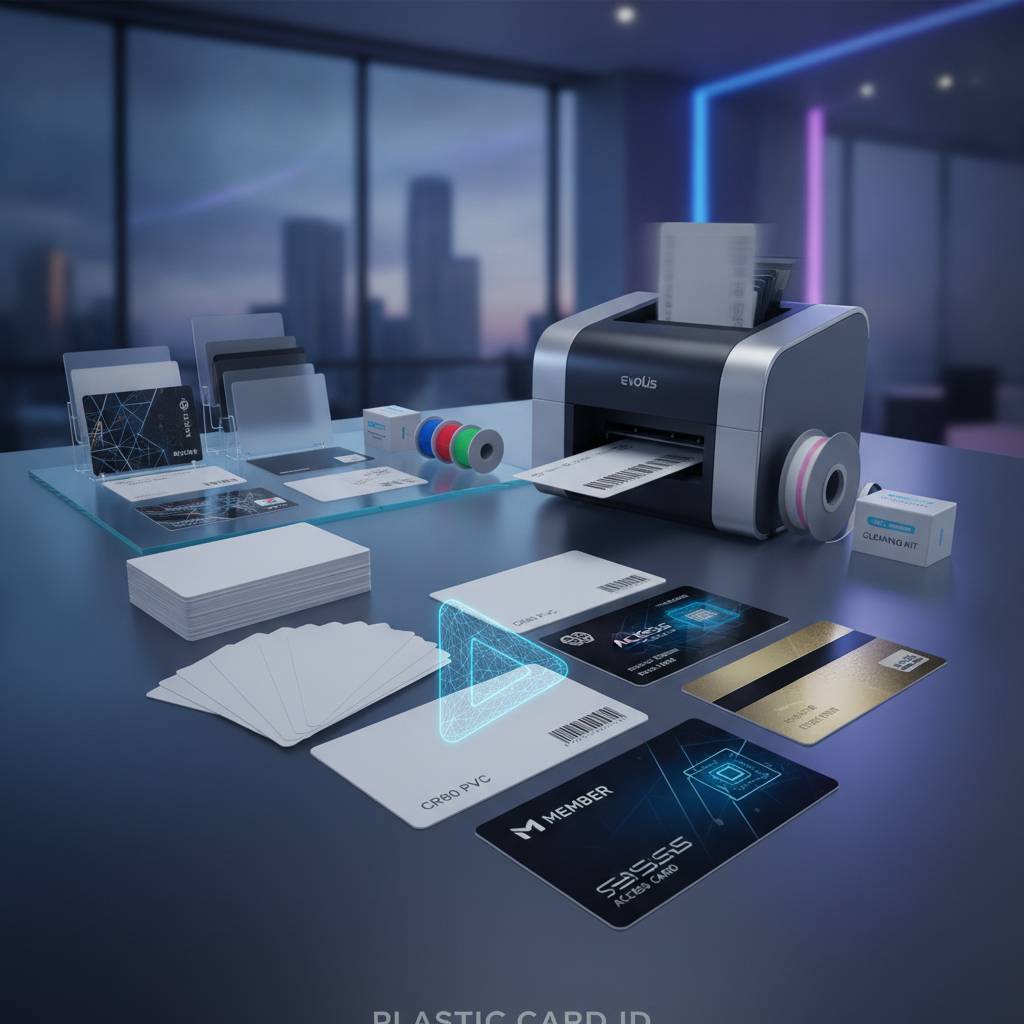
Plastic Card Printer for Access Control Cards: Best Models
Table of Contents []
- Why Plastic Card ID Is the Go-To Source for Plastic Card Printers for Access Control Cards
- What Makes Access Control Cards Different From Other Plastic Cards
- Choosing the Right Printer for Your Access Control Card Program
- Supplies and Accessories That Keep Your Card Program Running
- The Operational Case for In-House Access Control Card Printing
- Frequently Asked Questions About Plastic Card Printers for Access Control
- Partner With Plastic Card ID for Your Access Control Card Printing Program
Why Plastic Card ID Is the Go-To Source for Plastic Card Printers for Access Control Cards
Access control isn't just a security measure - it's a statement about how seriously your organization takes protecting its people, assets, and data. When a staff member badges through a secure door, that card represents a chain of trust: physical, digital, and organizational. And that chain is only as strong as the card - and the printer - behind it.
Plastic Card ID has spent over 25 years supplying professional plastic card printers to businesses across the United States, building a customer base of over 100,000 organizations. From compact desktop units for low-volume programs to high-throughput industrial systems for enterprise-scale deployments, CPE carries the hardware, supplies, and expertise to make any access control card program work exactly the way you need it to.
This page is your complete guide to choosing, buying, and operating a plastic card printer specifically for access control cards. Whether you're launching a brand-new ID program or upgrading outdated hardware, the information here will help you make a confident, well-informed decision.
| Printer Model | Best For | Monthly Volume | Encoding Options |
|---|---|---|---|
| Evolis Badgy200 | Small offices, low-volume programs | Under 1,000 cards/year | Standard print |
| Evolis Zenius | Mid-size organizations | 1,000-3,000/month | Magnetic stripe, smart chip |
| Evolis Primacy2 | Active access control programs | Up to 6,000/month | Magnetic stripe, smart chip, dual-sided |
| Evolis Agilia | Premium, edge-to-edge output | High-volume | Full encoding suite |
| Fargo / Zebra | Security-focused ID programs | Scalable | Magnetic stripe, smart chip, HID |
| Matica Event Printer | On-site, high-speed badge printing | High throughput | Configurable |
What Makes Access Control Cards Different From Other Plastic Cards
Not all plastic cards are created equal - and access control cards sit near the top of the complexity ladder. Unlike a basic loyalty card or a membership card that simply displays a logo and a name, an access control card must do considerably more. It has to carry encoded data, interface with electronic readers, and hold up under repeated daily use. That's a different engineering problem entirely.
The distinction matters enormously when you're choosing a printer. A printer that works fine for membership cards may be completely inadequate for access control applications if it lacks encoding capabilities or can't produce the print quality required for photo ID integration. Understanding what access control cards actually require is the essential first step.
The Role of Encoding in Access Control
Access control cards communicate with readers through encoded data, not just visual information. Magnetic stripe encoding stores data on a physical track embedded in the card, while smart chip encoding (contact or contactless) allows for far more sophisticated, encrypted data exchange. Most modern access systems rely on contactless smart card technology - think HID Proximity or MIFARE - which requires a printer equipped with the right encoding module.
When you print and encode in a single pass, you're not just saving time. You're eliminating the handling errors and data mismatches that can occur when printing and encoding happen separately. Printers like the Evolis Primacy2 and the Evolis Agilia support integrated encoding, making them natural choices for serious access control programs.
Photo ID Integration and Visual Security
Many organizations pair access control functionality with visual identification - printing a full-color photo, name, title, and department directly on the card surface. This dual-purpose approach adds a human verification layer that electronic readers alone can't provide. Full-color YMCKO ribbon printing is the standard here, delivering vibrant, durable output that resists fading and tampering.
Security features like UV overlays, holographic lamination, and microtext printing can be layered onto the card surface to further deter counterfeiting. These aren't luxury additions - for organizations managing access to sensitive areas, they're operational necessities. CPE carries the ribbons, lamination modules, and supplies to enable all of these features.
Durability Requirements for Daily Use
An access control card might be badged through a reader dozens of times each day. Over a year, that's thousands of swipes, taps, or insertions. The card surface must resist scratching, moisture, and general wear without compromising the readability of the encoded data. PVC card construction combined with quality lamination overlays delivers exactly this level of durability.
The printer you choose also affects card longevity. High-quality dye-sublimation printing with proper topcoat application produces cards that last years under normal use conditions. Printers from Evolis, Fargo, and Zebra - all available through Plastic Card ID - are specifically engineered to produce this caliber of output.
Choosing the Right Printer for Your Access Control Card Program
Walk into a purchasing decision without a clear picture of your requirements, and you'll either overspend on features you don't need or under-buy and create operational headaches. The right printer for your access control program depends on several intersecting factors: how many cards you print, how often, what encoding your system requires, and what level of card personalization you want.
CPE offers a genuinely curated lineup - not a warehouse of every printer ever made, but a focused selection of proven performers from Evolis, Fargo, Zebra, and Matica. Each of these brands has earned its place in the lineup through reliability, print quality, and compatibility with real-world access control deployments.
Low-Volume Programs: Starting Smart
If your organization issues fewer than 1,000 cards per year - think a small professional office, a boutique hotel, or a compact campus facility - the Evolis Badgy200 is worth a close look. It's a desktop unit that prints professional-grade cards without demanding enterprise-level investment. Setup is straightforward, and the learning curve is minimal even for staff with no prior card printing experience.
That said, organizations anticipating growth should think carefully before choosing the lowest-volume option. A printer that perfectly fits today's needs may become a bottleneck within 18 months. CPE can help you map out a realistic volume trajectory so you're not back shopping for hardware sooner than expected.
Mid-Range Workhorses for Active Programs
For organizations printing anywhere from 1,000 to 6,000 cards per month, the Evolis Zenius and Evolis Primacy2 are the standout performers. Both support magnetic stripe encoding and smart chip options, making them directly compatible with the most widely deployed access control architectures. The Primacy2 adds dual-sided printing, which is invaluable when you need to print on both faces of the card - employee information on the front, access level data or barcodes on the back.
These printers hit a sweet spot that a surprising number of organizations land in: serious enough throughput for real operational demands, compact enough for an office environment, and flexible enough to grow with a program as encoding needs evolve. Call 800.835.7919 to discuss which configuration makes the most sense for your volume and system requirements.
Enterprise and Premium Output: The Agilia and Beyond
When an organization demands the absolute highest print quality - edge-to-edge coverage, photographic-grade color, and the full encoding capability suite - the Evolis Agilia steps into its own. This is a premium-class printer designed for organizations that won't compromise on card appearance or functional performance.
Fargo and Zebra printers round out the high-end options, particularly for security-focused programs where credential integrity is paramount. These brands have deep roots in government, healthcare, and enterprise ID deployments, and their printers reflect that pedigree. If your access control program covers multiple facilities, high-security zones, or thousands of cardholders, these are the machines worth examining carefully.
| Feature | Why It Matters for Access Control |
|---|---|
| Smart Chip Encoding | Required for HID, MIFARE, and modern contactless systems |
| Magnetic Stripe Encoding | Compatible with legacy access readers and hotel systems |
| Dual-Sided Printing | Enables full use of both card faces for data and branding |
| Lamination Module | Adds security overlay and extends card lifespan |
| High-Capacity Input Hopper | Reduces manual reloading in high-volume environments |
Supplies and Accessories That Keep Your Card Program Running
A card printer without the right supplies is like a high-performance engine without fuel - technically impressive but operationally useless. Plastic Card ID supplies the full ecosystem of consumables and accessories that keep access control card programs running without interruption. Stocking up properly from the start saves time, reduces emergency purchasing headaches, and ensures consistent card quality.
The supplies side of card printing is often underestimated until something runs out at exactly the wrong moment. Proactive inventory management - knowing when to reorder ribbons, cleaning kits, and blank cards - is a competency that develops quickly once you've experienced a production halt mid-card-run.
Ribbon Selection for Access Control Cards
YMCKO ribbons are the workhorse of color card printing, combining yellow, magenta, cyan, black, and overlay panels into a single ribbon that produces full-color, protected output in one pass. For access control cards with photo ID, this is the standard choice. Monochrome ribbons - black, white, or specialty colors - are an option for single-color applications where cost-per-card efficiency is the priority.
Specialty ribbons exist for holographic overlays, UV-reactive printing, and other security applications. If your access control program includes high-security zones or credentials that need to be visually verifiable under examination, these ribbon types add meaningful protection against tampering and counterfeiting.
Cleaning Kits and Printer Maintenance
Card printer maintenance is not optional - it's operational. Dust, debris, and card residue accumulate inside the printer over time, degrading print quality and potentially damaging the printhead. Regular cleaning with manufacturer-recommended kits is the single most effective way to extend printer life and maintain consistent card output quality.
Most card printers include a cleaning cycle that uses pre-saturated cleaning cards or swabs to clear the card path and printhead. CPE stocks cleaning kits matched to the specific printer models it carries, so you're always using the right product for your equipment. Skipping maintenance cycles is a false economy that eventually results in expensive repairs or premature printer replacement.
Encoding Upgrades, Hoppers, and Card Carriers
Many printers can be upgraded with encoding modules after purchase, giving organizations flexibility to add magnetic stripe or smart chip capability as their access control system evolves. Encoding upgrade modules from Evolis, Fargo, and Zebra are available through Plastic Card ID, allowing you to expand functionality without replacing the entire printer.
High-capacity input hoppers reduce manual card loading in high-volume environments, while card carriers and sleeves protect finished credentials during distribution and daily carry. These aren't glamorous accessories, but they're genuinely impactful for operational efficiency and card longevity. A scratched or bent access control card can fail at a reader - a card carrier prevents that scenario entirely.
The Operational Case for In-House Access Control Card Printing
The decision to print access control cards in-house versus outsourcing to a third-party vendor isn't purely a cost calculation - it's a control calculation. Organizations that print in-house can issue a replacement card in minutes rather than days. They can encode and print simultaneously, maintaining data integrity. They can respond to personnel changes, access level updates, or security incidents immediately.
Third-party card production introduces lead times, shipping variables, and a dependency that can become genuinely problematic in fast-moving situations. In-house printing eliminates those vulnerabilities entirely. For organizations managing access to sensitive facilities, the operational argument for bringing card production in-house is compelling.
Print on Demand: The Tactical Advantage
Print-on-demand capability means a new employee can have a fully printed, fully encoded access control card on their first day - not their third week. It means a lost or compromised card can be deactivated and replaced within the same shift. This responsiveness isn't a luxury - it's a security feature. Every hour a former employee's access card remains valid after their departure is an hour of unnecessary exposure.
Organizations that have experienced the operational friction of waiting for externally produced cards universally appreciate the shift to in-house production. The upfront investment in a quality printer pays back quickly in time saved, security improved, and vendor dependencies eliminated.
Cost-Per-Card Economics
In-house card printing typically delivers a lower cost per card than outsourcing once the printer investment is amortized. For organizations printing hundreds or thousands of cards annually, the economics shift decisively in favor of in-house production within the first year or two of operation. Ribbons, blank cards, and cleaning supplies are the ongoing costs - and these are predictable, controllable, and far lower than per-card vendor pricing at volume.
Smaller organizations with genuinely low card volumes may find the math less clear-cut, but even then, the speed and control advantages often outweigh a modest cost premium. CPE can help you run a realistic cost comparison based on your actual program volumes and current outsourcing spend.
Who Is In-House Card Printing Right For?
- Corporate offices managing employee access credentials across one or multiple facilities
- Universities and schools issuing student and staff ID cards with access permissions
- Healthcare facilities requiring secure, photo-ID access credentials for staff and vendors
- Hotels and hospitality properties encoding key cards for guest rooms and restricted areas
- Government agencies and municipalities managing access to secure buildings and systems
- Manufacturing and industrial facilities controlling access to production floors and secure zones
- Event venues and conference organizers issuing on-site access credentials at scale
Frequently Asked Questions About Plastic Card Printers for Access Control
Buyers new to card printing often arrive with the same core questions. The answers aren't always simple - printer selection genuinely depends on program specifics - but these FAQs address the most common decision points clearly and practically.
What type of encoding do I need for my access control system?
The encoding type your printer needs depends entirely on your access control reader technology. HID Proximity cards require 125kHz RFID encoding; MIFARE and DESFire cards use 13.56MHz smart card technology. Magnetic stripe encoding is used in older systems and hotel key card applications. Your access control system vendor or IT team can confirm exactly which technology your readers use - that information directly determines which printer encoding module you need.
If you're uncertain, CPE can help you work through the options. Choosing the wrong encoding module is an expensive mistake - one that's easily avoided with the right guidance upfront. Contact the team at 800.835.7919 before purchasing if you have any uncertainty about encoding compatibility.
How many cards can I print per hour with these printers?
Print speed varies significantly by model and print mode. Single-sided color printing typically ranges from 100-150 cards per hour on mid-range printers, while higher-end models can push considerably further. Dual-sided printing and encoding add processing time but remain efficient at scale. For most office-based access control programs, print speed is rarely a bottleneck - batch printing during off-hours easily keeps pace with credential demand.
High-throughput environments - event credentialing, large-scale onboarding, or multi-facility card replacement programs - may benefit from higher-speed units or the Matica Event Printer, which is specifically engineered for rapid on-site badge production. Volume requirements are a key input when selecting the right printer for your program.
What is the typical lifespan of a card printer?
With proper maintenance, a quality card printer from Evolis, Fargo, or Zebra can deliver many years of reliable service. Printhead lifespan is typically measured in cards printed rather than years - many printheads are rated for 500,000 cards or more under normal operating conditions. Regular cleaning, using quality ribbons and blank cards, and avoiding environmental extremes all contribute to maximum printer longevity.
Organizations that neglect cleaning cycles or use incompatible supplies often experience premature printhead wear. This is a preventable problem. CPE stocks the correct cleaning kits and compatible ribbons for every printer model it carries, making it straightforward to maintain your equipment properly from day one.
Partner With Plastic Card ID for Your Access Control Card Printing Program
There's a meaningful difference between buying a printer and building a card program. The hardware matters, obviously - but so does having a supplier who understands how access control card printing actually works in practice, who carries the supplies to keep your program running, and who's reachable when questions arise. Plastic Card ID has been that supplier for over 100,000 businesses across the United States.
From the moment you first reach out, you're working with a team that knows card printers at a level most retailers simply don't. The curated lineup of Evolis, Fargo, Zebra, and Matica printers reflects 25 years of real-world feedback from real customers running real card programs. Nothing in the catalog is there by accident. Every model earns its place through demonstrated reliability and genuine utility for the customers who depend on it.
A Complete Supply Chain Under One Roof
Printers, ribbons, cleaning kits, encoding modules, lamination supplies, blank PVC cards, card carriers, and hoppers - CPE carries the complete ecosystem needed to run a professional access control card program without chasing supplies from multiple vendors. That consolidation saves time, simplifies purchasing, and ensures compatibility across every component in your setup.
Consistency in supplies matters more than most buyers initially realize. Using the correct ribbon type for your printer model, maintaining a regular cleaning schedule, and sourcing blank cards from a reliable supplier are the operational details that separate a card program that runs smoothly from one that produces headaches. Plastic Card ID makes all of that straightforward.
Ready to Get Started?
Take the next step toward a more secure, more efficient access control card program. Whether you're comparing models, estimating volume, or ready to place an order, the team at Plastic Card ID is ready to help.
Call 800.835.7919 to speak directly with a card printing specialist who can match your access control requirements to the right printer, supplies, and configuration - without the guesswork.
Contact Plastic Card ID today at 800.835.7919 and put 25 years of card printing expertise to work for your organization.
Previous Page