Direct-to-Card Printing vs Retransfer Printing: Key Differences
Table of Contents []
- Direct-to-Card Printing vs Retransfer Printing: Which Technology Does Your Organization Actually Need?
- Understanding Direct-to-Card Printing in Depth
- Retransfer Printing: Premium Output for Demanding Applications
- Buyer's Guide: Choosing the Right Technology for Your Card Program
- Consumables, Accessories, and Keeping Your Card Program Running
- Real-World Applications: Where Each Technology Performs Best
- Why Plastic Card ID Is the Right Partner for Your Card Printing Program
Direct-to-Card Printing vs Retransfer Printing: Which Technology Does Your Organization Actually Need?
Most buyers come into this decision already leaning one way or another - maybe a colleague recommended a specific printer, or a quick search pointed toward a brand name. But the real question, the one that actually determines whether you end up with a card program that works or one that frustrates, comes down to a fundamental technology choice: direct-to-card printing or retransfer printing? These two approaches to putting ink on plastic produce very different results, carry very different price tags, and suit very different operational environments.
At Plastic Card ID, we have spent decades helping organizations across every industry navigate exactly this decision. After serving more than 100,000 customers, our team has seen the full range of outcomes - organizations thrilled with an entry-level direct-to-card setup, others who upgraded to retransfer and never looked back. Understanding what separates these two technologies is the single most important step before any purchase.
What Is Direct-to-Card (DTC) Printing?
Direct-to-card printing works essentially how it sounds. A print head moves across the surface of a PVC card and deposits dye from a ribbon directly onto the card itself. The ribbon - typically a YMCKO panel ribbon containing yellow, magenta, cyan, black, and overcoat layers - transfers color in sequence, building a full-color image layer by layer. It is a proven, efficient process refined over decades of use in corporate, educational, and government environments.
The key characteristic of DTC printing is that the image does not extend all the way to the card's edges. A small but visible white border remains around the perimeter of the card. For many applications - employee ID cards, membership cards, loyalty programs - this is entirely acceptable. The cards look professional, crisp, and clean. But for programs requiring edge-to-edge imagery, the limitation matters significantly.
What Is Retransfer Printing?
Retransfer printing adds an intermediate step that changes everything. Instead of printing directly onto the card, the printer first creates the image on a clear retransfer film. That film is then thermally bonded onto the surface of the card. Because the film extends slightly beyond the card's boundaries before bonding, the result is true edge-to-edge, over-the-edge printing with no white border anywhere.
This process also means the print head never touches the card surface. That distinction has practical consequences: retransfer printers can print on textured, pre-laminated, and smart card surfaces with inconsistencies that would damage or confuse a direct-to-card print head. The image quality in retransfer output is consistently sharper, with richer color density and a more polished, photographic finish.
The Core Trade-Off Every Buyer Needs to Understand
Neither technology is universally superior. Direct-to-card printers are faster per card in many configurations, more affordable upfront, and easier to maintain. Retransfer printers deliver higher image quality and greater compatibility with advanced card constructions, but they cost more to purchase and more to operate due to the added film consumable. The right choice depends entirely on your card program's specific requirements.
Volume, card type, design complexity, security requirements, and budget all factor into this decision. An organization printing 200 basic employee ID cards per year has completely different needs than a hospital printing smart-chip access control credentials for thousands of staff. Both deserve the right tool, and CPE has both in stock.
| Feature | Direct-to-Card (DTC) | Retransfer |
|---|---|---|
| Print Method | Ribbon directly onto card | Image onto film, then film onto card |
| Edge-to-Edge Printing | No (white border remains) | Yes (full bleed) |
| Image Quality | Good to very good | Excellent, photographic |
| Card Surface Compatibility | Standard flat PVC cards | Textured, pre-laminated, smart cards |
| Print Speed | Faster (fewer steps) | Slightly slower per card |
| Hardware Cost | Lower | Higher |
| Cost Per Card | Lower | Higher (additional film consumable) |
| Best For | Standard IDs, memberships, loyalty | Security credentials, premium cards |
Understanding Direct-to-Card Printing in Depth
Direct-to-card printing is the backbone of corporate card programs worldwide. The technology's maturity means it is reliable, well-supported, and surrounded by a rich ecosystem of compatible consumables, ribbons, and accessories. For the vast majority of organizations printing standard identification or membership cards, DTC printers offer everything needed at a cost that makes practical sense.
What many buyers underestimate is how much variation exists within the DTC category itself. Entry-level machines like the Evolis Badgy200 sit at one end of the spectrum, well-suited to organizations printing fewer than 1,000 cards per year. Step up to the Evolis Zenius or Primacy2 and you gain speed, dual-sided printing capability, magnetic stripe encoding, and the throughput to handle 1,000 to 6,000 cards per month. Each level serves a distinct operational need.
Ribbon Types and Their Impact on Output
The ribbon choice in a DTC printer shapes the final card almost as much as the hardware itself. Full-color YMCKO ribbons produce vivid, photographic ID cards with a protective overcoat layer. Monochrome ribbons - black, blue, red, gold, silver - print single-color text and barcodes at significantly higher speeds and lower cost per card. Specialty ribbons like KO (black and overcoat) or scratch-off formulations expand what DTC printers can produce.
Plastic Card ID supplies the full ribbon spectrum for every compatible printer in its lineup. Matching the right ribbon to your specific print job is not a minor detail - it directly determines card durability, scan accuracy, and visual quality. Our team can walk any organization through the selection process to make sure nothing is left to guesswork.
Dual-Sided Printing: When Both Sides Matter
A significant portion of DTC printer buyers initially request single-sided units, then realize within months that they need both sides of the card. Employee ID cards often carry a photo and name on the front but need a barcode, magnetic stripe data, or secondary information printed on the reverse. Choosing a dual-sided capable printer from the start avoids a costly equipment replacement later.
Models like the Evolis Primacy2 handle dual-sided printing smoothly, flipping cards internally and printing both faces in a single pass through the printer. Organizations encoding magnetic stripes for access control or loyalty programs will find this configuration especially valuable - one machine handles personalization, printing, and encoding simultaneously.
Encoding Options in DTC Printers
Modern DTC printers support a range of encoding upgrades installed directly in the hardware. Magnetic stripe encoding writes data to the card's magstripe in a single pass alongside printing. Contact smart chip encoding and contactless RFID encoding modules are available for select models, enabling organizations to produce fully functional access control credentials, student IDs with library access, or membership cards tied to loyalty databases.
To learn more about encoding configurations or to discuss what your card program requires, call CPE at 800.835.7919. Our product specialists understand the technical side and can match the right encoding module to your exact use case without overspending on features you do not need.
Retransfer Printing: Premium Output for Demanding Applications
Retransfer technology occupies a different tier of the card printing market, and for organizations whose requirements demand it, the investment is unquestionably worthwhile. The image quality retransfer produces is simply not achievable by any DTC method. Color saturation is deeper, fine text and line detail is sharper, gradients render more smoothly, and edge-to-edge coverage eliminates the visual compromise of a white border.
Security-focused programs benefit enormously from retransfer. The film layer bonded over the card surface creates a physical barrier that is harder to tamper with than a standard DTC overcoat. Combined with holographic overlaminates and other security features, retransfer-printed credentials carry a level of visual integrity that matters in government, healthcare, and law enforcement contexts where counterfeiting resistance is not optional.
The Evolis Agilia: Premium DTC Meets Demanding Environments
Among the printers Plastic Card ID carries, the Evolis Agilia stands as the premium choice for organizations demanding the highest single-card output quality in a direct-to-card platform. Its architecture is engineered for consistent, high-quality edge-to-edge equivalent results and supports advanced encoding, making it suitable for enterprise environments where card quality reflects organizational credibility directly.
The Agilia suits organizations that need professional-grade output without the full cost infrastructure of a retransfer system. For many corporate and institutional card programs, it represents the ideal balance point - significantly above entry-level quality, engineered for demanding production environments.
Fargo and Zebra: Security-First Card Printing
Fargo and Zebra printers have earned their reputations in security-sensitive ID programs for good reason. Both brands build hardware with government and enterprise-grade security programs in mind, offering retransfer models that integrate seamlessly with access control systems, visitor management platforms, and credentialing software used by organizations that cannot afford card security failures.
Fargo's retransfer lineup delivers consistently professional results with excellent support ecosystems. Zebra's ZC and ZXP series span both DTC and retransfer categories, giving organizations a clear upgrade path as their card programs grow in complexity. Plastic Card ID carries both brands and can help you select the right model based on your software, security, and volume requirements.
The Matica Event Printer: Speed When Every Minute Counts
Event credentialing operates under a different set of pressures than a corporate HR department printing ten employee badges per week. When 500 attendees need printed, encoded badges at check-in within a two-hour window, throughput is everything. The Matica Event Printer is purpose-built for exactly this high-speed on-site credential printing demand, delivering reliable output under conditions that would stress standard desktop printers.
Organizations running conferences, trade shows, corporate events, or academic orientation days will find the Matica's speed and reliability genuinely game-changing. Paired with the right badge design software and a structured check-in workflow, it transforms what is otherwise a logistical pressure point into a smooth operational process.
Buyer's Guide: Choosing the Right Technology for Your Card Program
Selecting between DTC and retransfer is not always a straightforward decision, especially for organizations new to in-house card printing. Several questions can quickly clarify which direction makes sense, and understanding them before speaking with a supplier will save significant time and potential mismatches between equipment and need.
The most common mistake buyers make is treating the printer as the only variable. In reality, the total cost of a card program includes ribbons, cleaning kits, blank cards, and any encoding consumables - and these ongoing costs accumulate over years. A DTC printer with lower upfront cost but higher ribbon consumption for a high-volume program may ultimately cost more than a retransfer setup with better cost-per-card economics at scale.
Key Questions to Ask Before You Buy
- How many cards will you print per year, and will that volume grow significantly in the next three years?
- Does your card design use edge-to-edge imagery, or is a standard white border acceptable?
- Will your cards require magnetic stripe encoding, smart chip, or contactless RFID capability?
- Are your cards standard flat PVC, or do they include pre-laminated layers, textured surfaces, or embedded chips that need retransfer compatibility?
- What is your total budget - not just for the printer, but for annual consumables over a three-year period?
- Does your organization require specific security features such as holographic overlaminates or UV fluorescent printing?
Volume-Based Recommendations
For organizations printing under 1,000 cards per year, the Evolis Badgy200 represents exceptional value - compact, easy to operate, and producing quality output for basic ID and membership programs. No retransfer technology is needed or economically justified at this scale for most standard applications.
Mid-range programs producing 1,000 to 6,000 cards per month gain significantly from the Evolis Zenius or Primacy2, both of which support dual-sided printing and encoding upgrades that grow with the program. Organizations consistently at the upper end of this range or higher should seriously evaluate retransfer options for their improved durability and output quality at sustained production volumes.
Talking to a Specialist Before Committing
No buyer's guide replaces a direct conversation with someone who knows these machines inside and out. Plastic Card ID has been matching card programs to the right hardware since before many of today's card printing brands even existed. Call 800.835.7919 and describe your program - our team will ask the right questions and give you a straight answer on which technology actually fits your needs.
We do not push buyers toward more expensive equipment than they require. A customer who gets the right printer for their actual program stays a customer. That philosophy, sustained over 25 years and across more than 100,000 customers, is the foundation of how CPE operates.
Consumables, Accessories, and Keeping Your Card Program Running
The printer is the centerpiece, but a card program runs on its consumables. Ribbons run out. Cleaning rollers accumulate debris that degrades print quality over time. Lamination modules need film replacement. Encoding modules occasionally need calibration. An organization that plans only for the hardware purchase and not for the ongoing supply chain is setting itself up for preventable disruptions.
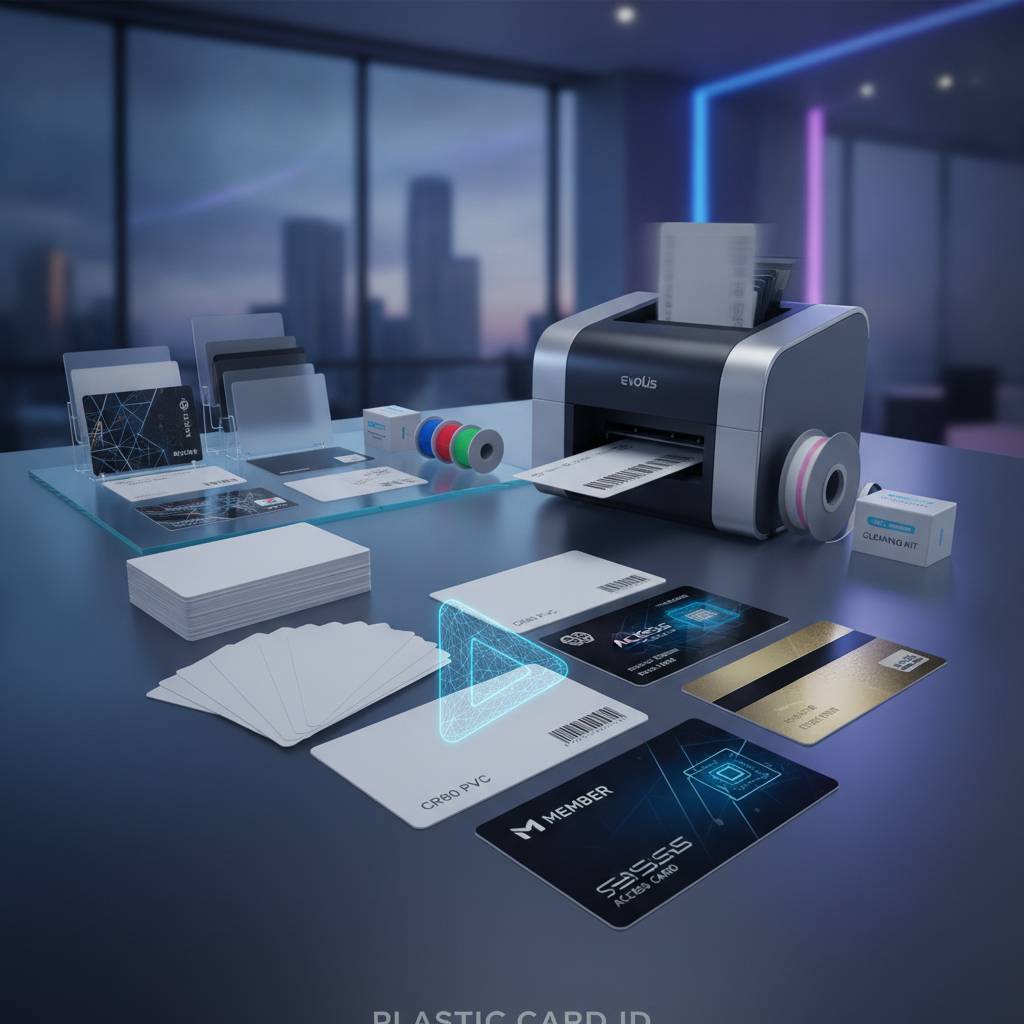
Plastic Card ID stocks the complete range of consumables for every printer in its lineup. Printer ribbons in YMCKO full-color, monochrome, and specialty formats. Cleaning kits - cleaning cards, cleaning swabs, cleaning rollers - engineered for each specific printer model. Lamination film for modules that add an additional protective layer to finished cards. And blank PVC card stock in standard CR-80 size for use across all compatible printers.
Ribbons: Matching Consumables to Output Goals
Full-color YMCKO ribbons are the workhorse of most ID card programs, producing cards with photo-realistic imagery and a clear protective overcoat in a single print cycle. For programs printing primarily text-based information - names, departments, barcodes - monochrome ribbons cut cost per card dramatically while maintaining excellent scan accuracy for barcode and QR code applications.
Specialty ribbons including scratch-off, metallic, and UV-reactive formulations expand what a single printer can produce, making it possible to add security features or decorative elements without separate equipment. Getting the ribbon selection right is as important as getting the printer selection right - CPE carries them all and can set up automatic replenishment for high-volume programs.
Cleaning and Maintenance: The Overlooked Factor in Print Quality
Print head contamination is the single most common cause of declining card quality in programs that start strong and gradually degrade. Dust, card debris, and ribbon residue accumulate on print heads and transport rollers, introducing streaks, color banding, and encoding errors that frustrate end users and damage organizational credibility. A disciplined cleaning schedule prevents the vast majority of these issues entirely.
Most manufacturers recommend cleaning every ribbon change at minimum, with deeper cleaning cycles at defined card count intervals. Plastic Card ID supplies the correct cleaning kits for each printer model - not generic substitutes, but the properly engineered cleaning materials that maintain print head performance and protect warranty coverage.
Input Hoppers, Card Carriers, and Program Accessories
High-volume programs benefit from expanded input hoppers that increase card capacity without requiring operator attention for every batch. Card carriers protect pre-laminated and specialty cards during transport through the printer mechanism. Card sleeves and lanyards complete the credential package for employee ID, event badge, and visitor management applications.
Plastic Card ID supplies the full accessory range - not as an afterthought, but as an integrated part of building a card program that functions reliably from day one. Call 800.835.7919 to discuss what accessories your specific printer model and program design require.
Real-World Applications: Where Each Technology Performs Best
Understanding the technology in abstract terms is useful. Seeing how it plays out across actual card program types makes the decision concrete. Organizations across industries have distinct requirements that map predictably onto one technology or the other - and understanding those patterns helps any buyer move faster toward the right choice.
Corporate HR departments printing employee ID badges with photo, name, department, and barcode on standard flat PVC cards are classic DTC candidates. The white border is irrelevant to the card's function, volume is manageable, and the cost savings of DTC over retransfer are significant at this scale. Hospitals issuing smart-chip-enabled staff credentials with photo-quality output and tamper-evident finishes are retransfer candidates almost by definition.
Employee ID and Access Control Programs
Mid-size organizations issuing employee IDs with magnetic stripe or proximity chip encoding for door access represent the largest single category of card printer buyers. For most of these programs, a dual-sided DTC printer with magnetic stripe encoding handles everything needed at a compelling price point. The Evolis Primacy2 is a natural fit for this application, combining reliable throughput with encoding capability in a compact footprint.
Larger organizations or those operating in regulated industries where credential appearance matters beyond function - healthcare, government contractors, financial institutions - often find that retransfer quality justifies the additional investment. When your ID card is the first thing a visitor or patient sees, its appearance communicates organizational quality whether or not that is the intent.
Membership, Loyalty, and Event Programs
Membership and loyalty card programs typically prioritize consistent quality at moderate volume and the ability to encode magnetic stripes for point-of-sale systems. DTC printers excel in this environment, producing clean, professional cards in batches that fit naturally into weekly or monthly issuance cycles. The Evolis Zenius and similar mid-range models are popular in fitness centers, libraries, clubs, and retail loyalty programs for exactly these reasons.
Event credential programs operate on their own logic entirely. The Matica Event Printer addresses the throughput demand of large-scale on-site credentialing with a design philosophy built around burst printing rather than steady-state production. Organizations that run annual conferences or multi-day events often find that investing in purpose-built event printing hardware pays back in reduced check-in time and attendee experience improvements alone.
Student ID and Campus Programs
Universities and K-12 institutions printing student IDs face a combination of moderate annual volumes, mandatory photo personalization, and increasingly common smart card requirements for library, cafeteria, and facility access. Campus card programs are among the most technically complete card programs in operation, often requiring dual-sided printing, magnetic stripe encoding, contactless RFID encoding, and integration with campus management software.
The right hardware for a campus program is almost always a mid-to-upper-range DTC printer with multiple encoding options installed, or a retransfer printer where campus branding standards demand premium card appearance. CPE has supported campus card programs across the country and understands the specific requirements that educational institutions bring to these purchases.
Why Plastic Card ID Is the Right Partner for Your Card Printing Program
Depth of inventory, breadth of expertise, and a genuine commitment to matching buyers with the right equipment - these are not marketing abstractions at Plastic Card ID. They are the operational principles that have sustained this business through more than 25 years and across relationships with more than 100,000 customers nationwide. The card printing market has changed dramatically over that span, and staying relevant required knowing the technology at a level that goes beyond catalog listings.
When you call CPE, you reach people who have had this specific conversation hundreds of times and who understand the difference between a buyer who needs a Badgy200 and one who needs an Agilia or a retransfer system. That difference matters enormously to your program's success and to your budget. Getting it right from the first conversation is the entire point.
A Complete Card Program From One Source
There is a real operational advantage to sourcing your printer, ribbons, cleaning kits, blank cards, encoding upgrades, and accessories from a single supplier who knows how they interact. Troubleshooting becomes faster. Reorder processes become simpler. Your card program does not have to stop because a ribbon shipment got delayed from an unfamiliar vendor - Plastic Card ID maintains stock and ships with the reliability a business-critical program demands.
From a 200-card-per-year desktop setup to a multi-printer corporate issuance department running thousands of credentials per month, Plastic Card ID has configured and supplied programs at every scale. That range of experience translates directly into better advice for every new customer regardless of where their program falls on the spectrum.
No Financial Card Processing Equipment
A point worth clarifying for any organization exploring card printing for the first time: Plastic Card ID focuses exclusively on the printing and personalization of plastic identification and credential cards. We do not supply financial credit or debit card processing equipment or the infrastructure associated with payment card issuance. Our expertise is in the physical card and the hardware that produces it - and within that domain, few suppliers in the United States can match our depth.
If your program involves employee IDs, membership cards, loyalty programs, access control credentials, student IDs, hotel key cards, event badges, or any other non-payment card application, you are in exactly the right place. The technology, the hardware, and the expertise are all here.
Start the Conversation Today
Ready to move forward but still uncertain whether direct-to-card or retransfer printing is right for your program? The fastest path to clarity is a direct conversation with a product specialist who has guided hundreds of similar decisions. Call 800.835.7919 and describe your program - volume, card design, encoding needs, and budget. We will give you a straight, experience-backed recommendation.
Plastic Card ID carries the full range of professional card printers from Evolis, Fargo, Zebra, and Matica, along with every consumable and accessory your program needs. Whether you are launching a new card program or upgrading equipment that no longer meets your requirements, the right solution is available and ready to ship.
Contact Plastic Card ID today at 800.835.7919 - your card program deserves hardware and expertise matched to its actual needs, and that is exactly what we deliver.
Previous Page