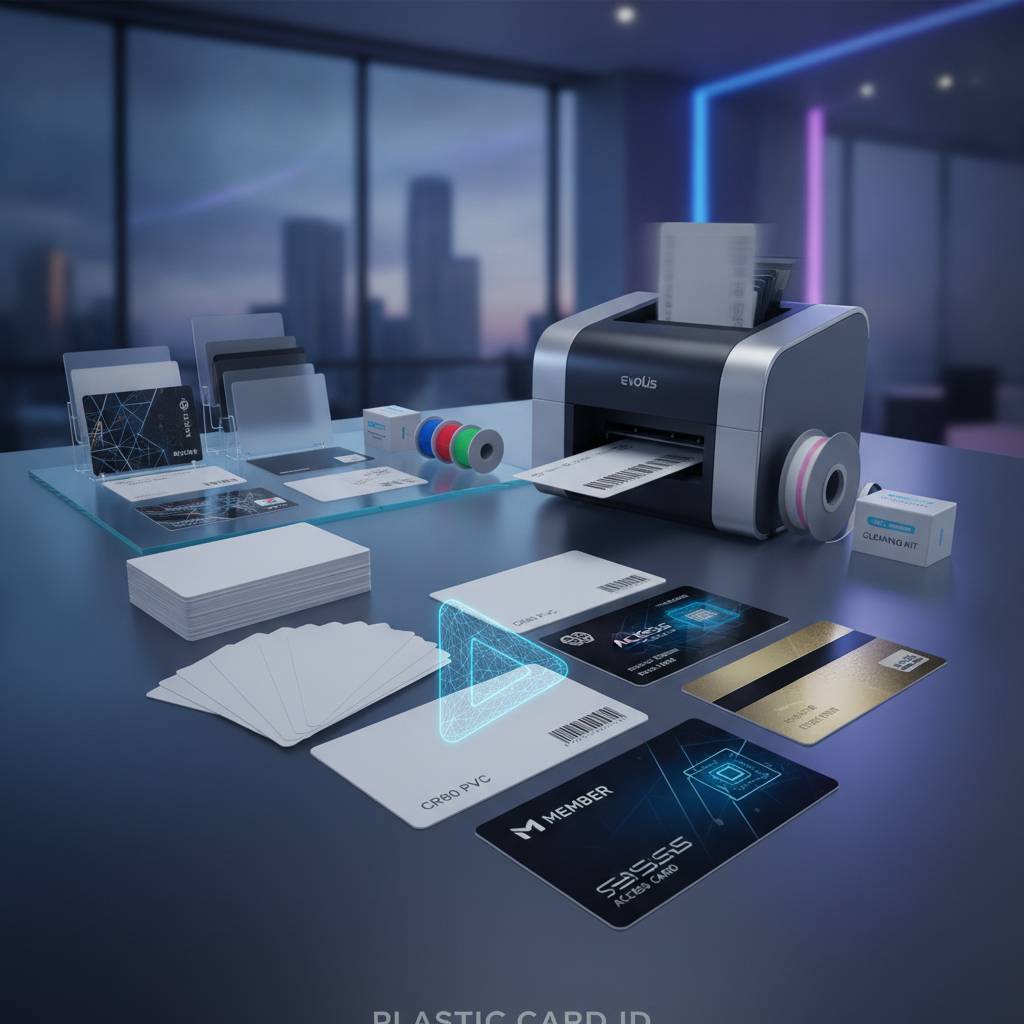
Evolis Agilia Card Printer: Advanced ID Printing Solution
Table of Contents []
- Why the Plastic Card ID Team Recommends the Evolis Agilia for Demanding Card Programs
- What Makes the Evolis Agilia Card Printer a Premium-Tier Choice
- Encoding Capabilities That Make the Agilia a Complete Solution
- Who Should Be Using the Evolis Agilia?
- Supplies and Consumables: Keeping the Agilia Running at Peak Performance
- Comparing the Agilia to Other Evolis Printers in the Lineup
- Frequently Asked Questions About the Evolis Agilia Card Printer
- Get the Evolis Agilia Through Plastic Card ID - The Right Printer, The Right Partner
Why the Plastic Card ID Team Recommends the Evolis Agilia for Demanding Card Programs
Some card printers do the job. Others redefine what the job looks like. The Evolis Agilia card printer sits firmly in the second category - a machine built for organizations that simply will not compromise on output quality, throughput, or long-term reliability. It is the kind of equipment that makes ID program managers stop second-guessing and start printing.
At Plastic Card ID, we have spent well over two decades matching businesses across the United States with the right card printing hardware. We have seen what happens when organizations outgrow their equipment, and we have also seen what happens when the right printer lands on the right desk. The Agilia is consistently the recommendation when the stakes are high and the volume is real.
Whether your organization prints employee credentials, access control cards, membership IDs, hotel key cards, or event badges, the Agilia delivers results that look and perform exactly as professional as your brand demands. Let us walk through exactly what makes this printer stand out - and how to know if it is the right fit for your operation.
| Feature | Specification |
|---|---|
| Print Technology | Dye Sublimation / Thermal Transfer |
| Print Coverage | Edge-to-Edge, Full Surface |
| Print Speed (Single-Sided) | Up to 150 cards/hour |
| Card Compatibility | CR-80 Standard PVC Cards |
| Encoding Options | Magnetic Stripe, Smart Chip (Contact/Contactless) |
| Connectivity | USB, Ethernet |
| Input Hopper Capacity | Up to 200 cards |
| Lamination Module | Available |
What Makes the Evolis Agilia Card Printer a Premium-Tier Choice
The word "premium" gets overused. In card printing, it means something specific: edge-to-edge color coverage with no white borders, consistent dye sublimation output across every single card in a run, and a build quality that holds up through thousands of print cycles without degradation. The Evolis Agilia delivers on all three fronts in a way that mid-range printers simply cannot.
What separates the Agilia from its peers in the Evolis lineup is the combination of high print resolution and a design philosophy centered on uninterrupted production. Organizations that cannot afford downtime - hospitals, universities, corporate campuses, security-conscious enterprises - will find that the Agilia was engineered with their reality in mind. This is not a printer you babysit. It is a printer that works.
Edge-to-Edge Printing: The Detail That Changes Everything
Most card printers leave a thin white border around the card's perimeter. For internal ID cards used in a back office, that might be acceptable. For branded membership cards, premium access credentials, or guest-facing hospitality IDs, it is not. Edge-to-edge printing is the standard the Agilia sets, and once you see it, going back feels like a step backward.
The visual difference is immediately apparent. Cards printed on the Agilia look finished, intentional, and polished in a way that reflects well on the issuing organization. Brand logos extend to the card's full surface. Background gradients reach every corner. The result is a card that communicates professionalism before a single word on it is even read.
Dye Sublimation Technology and Color Accuracy
Dye sublimation works by transferring color from a ribbon onto the card surface using precisely controlled heat. The result is a continuous-tone image - smooth gradients, accurate skin tones in portrait photos, vivid color fields - that looks photographic rather than digitally printed. The Agilia's print engine is optimized to get the most out of this process at high speed without sacrificing accuracy.
For organizations printing photo ID cards, the color fidelity of the Agilia is particularly notable. Faces look natural. Text renders crisply. Color panels from YMCKO ribbons produce output that holds up under scrutiny. This matters enormously when cards serve as official identification - every card needs to look as good as the last one.
Built for Volume Without Compromise
The Agilia's input hopper accommodates up to 200 cards, and its throughput of up to 150 cards per hour makes it well-suited for organizations running meaningful daily print volumes. Large corporations issuing credentials to new hires, healthcare networks printing patient-facing ID cards, universities onboarding students at the start of a semester - all of these scenarios benefit from a printer that does not slow the process down.
Beyond raw speed, the Agilia is built to sustain that speed over time. The internal mechanics are designed for durability, and Evolis's reputation for long-service-life printers is well-earned. Maintenance is straightforward, and when CPE pairs the Agilia with regular cleaning kits and quality ribbons, the printer performs consistently across its full expected lifespan.
Encoding Capabilities That Make the Agilia a Complete Solution
A card printer that only prints is useful. A card printer that prints and encodes is transformative. The Agilia supports magnetic stripe encoding, contact smart chip encoding, and contactless smart chip encoding - making it possible to produce fully functional access control credentials, loyalty cards with embedded data, and multi-application ID cards entirely in-house.
This matters because the alternative is splitting your card program across multiple vendors - one for printing, one for encoding. The Agilia consolidates that workflow into a single pass. One printer. One ribbon. One output tray. Fully personalized, fully encoded cards ready for immediate deployment.
Magnetic Stripe Encoding
Magnetic stripe encoding remains the most widely used card data technology across access control, loyalty programs, time-and-attendance systems, and hospitality applications. The Agilia's magnetic stripe encoding module reads and writes to ISO standard magnetic stripe cards with the same precision applied to the print process - meaning encoding errors are rare and data integrity is consistent.
For organizations upgrading from outsourced card production to in-house printing, magnetic stripe capability is often the feature that makes the switch financially compelling. Encoding cards on-site eliminates vendor setup charges per card run and puts control of the data in your hands rather than a third-party print shop's hands.
Smart Chip Options: Contact and Contactless
Smart chip credentials are increasingly the standard for high-security access control and multi-application ID programs. The Agilia supports both contact smart card encoding - where the chip is physically accessed via gold contact pads - and contactless encoding, where the card communicates via RFID at short range. This dual capability makes the Agilia suitable for a wide range of credential applications without requiring separate hardware.
For organizations implementing or upgrading access control systems, being able to produce smart chip credentials on-site is a significant operational advantage. New employees can be issued encoded access cards within hours of onboarding rather than waiting days for vendor fulfillment. That responsiveness has real value in fast-moving enterprise environments.
Lamination for Added Durability and Security
Lamination modules extend the Agilia's capabilities further by applying a protective overlay to printed cards. This overlay dramatically increases the card's resistance to physical wear - scratching, fading, and surface abrasion - while also adding a layer of visual security in the form of holographic or custom laminate options that are extremely difficult to replicate.
For organizations where card authenticity matters - government agencies, educational institutions, corporate campuses - lamination transforms a printed card into a tamper-evident credential. The Agilia's lamination integration is seamless, meaning the add-on does not slow the overall print process meaningfully, and the finished product is notably more durable than a standard printed PVC card.
Who Should Be Using the Evolis Agilia?
Not every organization needs the Agilia. That is an honest thing to say, and it is the kind of assessment Plastic Card ID has always given customers - matching the equipment to the actual need rather than pushing the highest-margin option. If you are printing fewer than a few hundred cards per year, an entry-level printer like the Evolis Badgy200 likely serves you better. But there is a clear profile of organization for which the Agilia is the right answer.
Large enterprises, mid-to-large universities, healthcare networks, hospitality groups, and security-focused government operations are the core Agilia customer. These organizations share a common set of needs: high volume, demanding quality standards, encoding requirements, and minimal tolerance for equipment failure. The Agilia addresses all of them.
Corporate and Enterprise ID Programs
Enterprise companies onboarding employees, issuing visitor credentials, or managing access control across multiple facilities understand the frustration of slow card production. Waiting for an outside vendor to print and ship ID cards - sometimes taking days or weeks - creates real friction in onboarding processes and access control management. In-house printing on the Agilia eliminates that delay entirely.
Corporate customers also tend to have rigorous brand standards. The Agilia's edge-to-edge output and color accuracy mean that every employee ID, contractor badge, or visitor card looks exactly as designed. No color drift between print runs. No white borders cropping your brand assets. Consistent, professional output every time the printer runs.
Higher Education and Student ID Programs
Universities and colleges print student IDs, faculty credentials, library cards, and event passes at scale. Semester starts and new student orientations demand the ability to print hundreds of cards in short windows of time. The Agilia's throughput and large hopper capacity make it genuinely capable of handling these burst-demand scenarios without creating queues that slow down registration operations.
Student IDs also increasingly serve as access control credentials, meal plan cards, and contactless payment tokens depending on campus infrastructure. The Agilia's smart chip and magnetic stripe encoding capabilities mean universities can consolidate these functions onto a single card produced entirely on-site - a meaningful reduction in program complexity and vendor dependency.
Healthcare and Hospitality Applications
Healthcare organizations produce patient ID wristbands and staff credentials that must be clear, accurate, and sometimes encoded. Hospitality groups - hotels, resorts, cruise lines - produce guest key cards that need to look as premium as the guest experience they represent. Both sectors benefit from the Agilia's combination of print quality, encoding capability, and production reliability.
In healthcare particularly, the ability to produce an ID card or encoded credential immediately when a new staff member starts - rather than waiting for an outside batch order - has workflow and security implications. The Agilia makes that on-demand model possible at a scale and quality level appropriate for professional healthcare environments.
Supplies and Consumables: Keeping the Agilia Running at Peak Performance
A card printer is only as good as the consumables running through it. Plastic Card ID supplies the full range of materials needed to support the Agilia's operation - from YMCKO color ribbons to monochrome black ribbons, specialty overlay ribbons, cleaning kits, and lamination film. Using the correct supplies is not optional - it is the difference between consistent output and inconsistent headaches.
Evolis recommends specific ribbon types for the Agilia, and for good reason. Third-party ribbons may appear to work initially, but color accuracy suffers, print heads wear faster, and the printer's calibration - which is designed around Evolis-certified consumables - produces suboptimal results. Sticking with manufacturer-recommended ribbons protects your print quality and your printer's longevity.
YMCKO Ribbons and Color Output
The YMCKO ribbon - Yellow, Magenta, Cyan, Black, and Overlay - is the standard consumable for full-color card printing. Each panel applies sequentially during the print process, with the overlay panel providing a protective clear coat over the finished image. For most ID card and credential applications, the YMCKO ribbon is the correct choice.
Ribbon yield varies by coverage area - cards with heavy full-color backgrounds consume more ribbon per card than cards with mostly white space and a small photo. For high-volume operations, understanding your average ribbon yield per batch helps with accurate supply budgeting. CPE customers who order ribbons regularly through Plastic Card ID benefit from having a reliable supply chain already in place.
Cleaning Kits and Preventive Maintenance
Evolis designs its cleaning process to be straightforward - cleaning cards and cleaning swabs work through the printer's feed path and print head area to remove dust, card debris, and ribbon residue that accumulates during normal operation. Regular cleaning intervals keep print quality consistent and prevent the kind of gradual degradation that catches organizations off-guard after months of infrequent maintenance.
The rule of thumb is simple: clean the printer every time you change the ribbon. That rhythm keeps the print head in optimal condition, protects the card feed path, and ensures that every batch of cards looks as good as the first batch printed after installation. Plastic Card ID includes cleaning kits with many printer purchases and sells them separately for ongoing supply orders.
Card Stock, Carriers, and Sleeves
The Agilia prints on standard CR-80 PVC cards - the same size and material as a standard credit card. Card quality matters: lower-grade PVC stock can cause feeding issues, produce uneven color absorption, and generate more debris inside the printer over time. Professional-grade card stock, like the kind Plastic Card ID supplies, is designed to work properly with card printers and produces predictably excellent results.
Beyond blank card stock, many organizations need card carriers for mailing finished cards to recipients, and card sleeves or holders for protecting credentials once issued. These finishing supplies round out a complete in-house card program and are available alongside printer hardware and consumables through Plastic Card ID.
Comparing the Agilia to Other Evolis Printers in the Lineup
Context helps. The Agilia is Evolis's premium offering, and understanding where it sits relative to the rest of the lineup clarifies who needs it and who might be better served by a different model. Plastic Card ID carries the full Evolis range precisely because different organizations have genuinely different requirements.
The Evolis Badgy200 starts the lineup - ideal for low-volume applications under 1,000 cards per year. The Evolis Zenius and Primacy2 handle mid-range volumes of 1,000 to 6,000 cards per month with single or dual-sided printing. The Agilia sits above all of them, designed for organizations that need edge-to-edge output at higher throughput with full encoding flexibility.
Agilia vs. Primacy2: When to Upgrade
The Primacy2 is an excellent, capable printer that satisfies most mid-volume card programs effectively. The decision to move to the Agilia typically comes down to three factors: you need edge-to-edge printing without exception, your volume has exceeded what the Primacy2 handles comfortably, or you need integrated lamination for security overlays. If any of those are true, the Agilia is the right next step.
Organizations sometimes start with a Primacy2 and upgrade to the Agilia as their card program grows. That path is straightforward - Plastic Card ID supports both models and can assist with the transition, including ribbon compatibility and software configuration. The growth path within the Evolis lineup is well-defined and well-supported.
Fargo and Zebra Options for Comparison
Beyond Evolis, Plastic Card ID also carries Fargo and Zebra card printers - both strong brands with loyal enterprise followings. Fargo printers, including the HDP series, are known for their high-definition printing process that places a transfer film between the ribbon and the card for exceptional image quality and card durability. Zebra printers are widely favored in large-scale enterprise environments for their integration with existing Zebra device ecosystems and robust driver support.
The choice between Evolis Agilia, Fargo HDP, and Zebra ZC series printers often comes down to existing infrastructure, IT integration requirements, and workflow specifics. Plastic Card ID advisors work through these comparisons with customers regularly - there is no single right answer, but there is always a best answer for each specific situation.
Frequently Asked Questions About the Evolis Agilia Card Printer
Customers considering the Agilia often arrive with specific, practical questions. The answers below reflect the most common points of inquiry that Plastic Card ID addresses when working with new and existing customers evaluating this printer.
What type of ribbons does the Evolis Agilia use?
The Agilia uses Evolis-certified ribbons in YMCKO (full color with overlay), monochrome black, and specialty configurations. The YMCKO ribbon is standard for most card applications involving color printing, photo IDs, or branded credentials. Monochrome ribbons offer faster print speeds and lower per-card cost for applications where color is not required.
Ribbon pricing varies by type and yield. Plastic Card ID supplies Agilia-compatible ribbons and can help customers calculate approximate cost-per-card based on their specific card design and volume profile. Accurate ribbon budgeting is one of the practical advantages of working with an experienced supplier rather than sourcing consumables piecemeal.
Can the Agilia print dual-sided cards?
Yes. The Agilia supports duplex (dual-sided) printing, which is essential for most professional ID card designs. Employee IDs typically carry a photo, name, and title on the front with access control information or barcodes on the reverse. Membership cards often feature branding on the front and terms or magnetic stripe placement on the back. Dual-sided capability is standard for the Agilia's use cases.
Duplex printing does reduce throughput slightly compared to single-sided print speed, but the Agilia manages this efficiently. For organizations printing large batches of dual-sided cards, the Agilia's throughput remains competitive with other professional-tier printers and is unlikely to create workflow bottlenecks in most standard card program scenarios.
How do I get support and service for the Evolis Agilia?
Support begins with choosing the right supplier. Plastic Card ID has supported card printing programs across the United States for over 25 years, and that experience is directly available to Agilia customers. From initial setup assistance and driver configuration to ongoing troubleshooting and consumables sourcing, working with CPE means having a knowledgeable resource in your corner for the life of the equipment.
- Setup and installation guidance for new Agilia deployments
- Ribbon and consumable compatibility support
- Encoding configuration assistance for magnetic stripe and smart chip setups
- Cleaning and maintenance schedule recommendations
- Upgrade path consultation as card program volumes evolve
- Lamination module integration support
Reach the Plastic Card ID team directly at 800.835.7919 to discuss your Agilia purchase, get answers to specific technical questions, or request a compatibility assessment for your existing card program infrastructure.
Get the Evolis Agilia Through Plastic Card ID - The Right Printer, The Right Partner
The Evolis Agilia card printer is not the right choice for every budget or every print volume. But for organizations where output quality is non-negotiable, encoding functionality is required, and print volume demands a machine built for sustained professional use, it is the clear recommendation. The Agilia is where premium card printing capability and real-world operational reliability converge in a single, well-engineered platform.
Plastic Card ID brings 25-plus years of card printing expertise and a customer base of over 100,000 businesses to every recommendation we make. We carry the Agilia because it consistently delivers for our customers - and we back every sale with the kind of product knowledge and ongoing support that makes a difference over the long run. This is not a transactional purchase. It is a partnership with a supplier who knows the equipment, knows the consumables, and knows your industry.
If you are evaluating the Evolis Agilia card printer for your organization, the next step is simple: talk to someone who has placed hundreds of these machines in real-world environments and knows exactly what to expect. Contact Plastic Card ID today at 800.835.7919 and let us help you build a card program that performs at the level your organization demands.
Previous Page