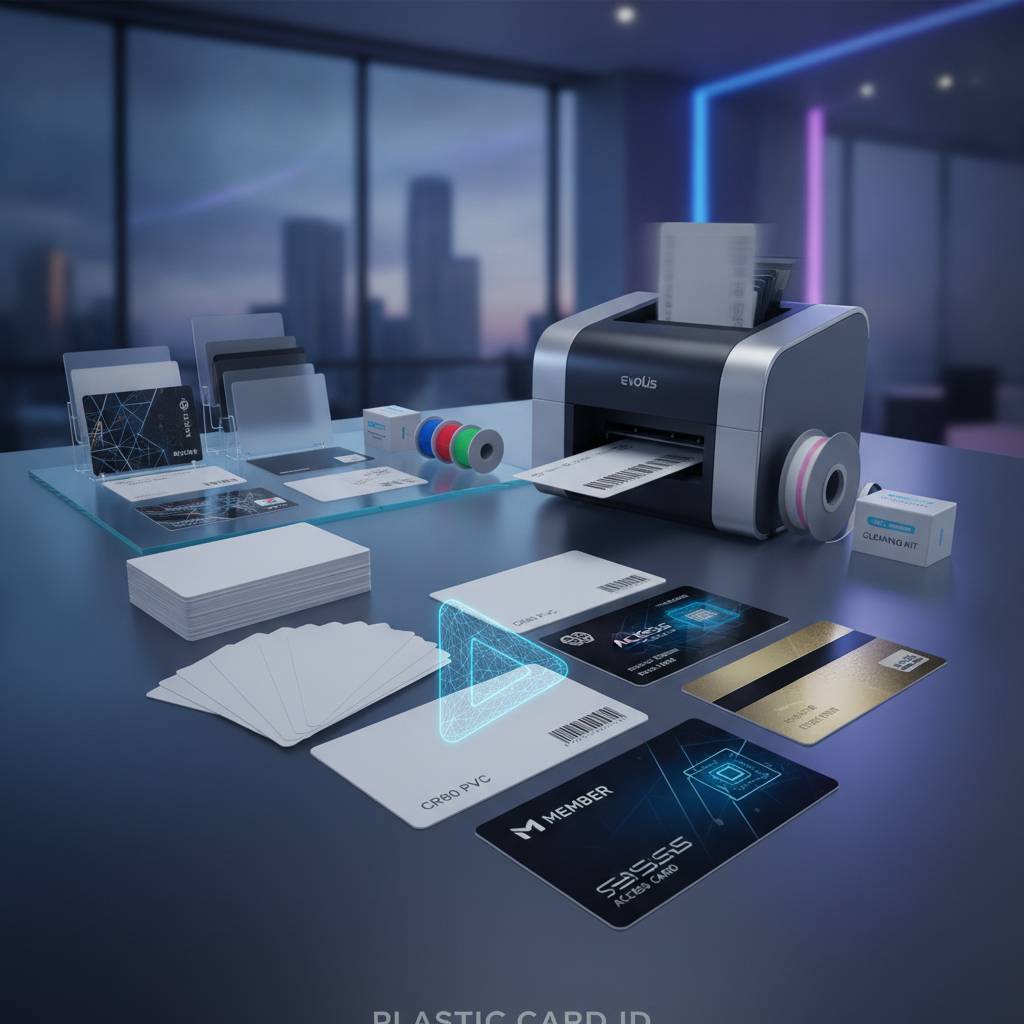
Dye Sublimation Card Printer Explained: How It Works
Table of Contents []
- What Plastic Card ID Wants You to Know About Dye Sublimation Card Printers
- Why Dye Sublimation Beats Other Card Printing Methods
- Choosing the Right Dye Sublimation Printer for Your Volume
- Ribbons, Supplies, and the Real Cost of Printing
- Industries and Applications Served by In-House Dye Sublimation Card Printing
- Buyer's Guide: What to Ask Before You Purchase a Dye Sublimation Card Printer
- Start Your Card Program Right With Plastic Card ID
What Plastic Card ID Wants You to Know About Dye Sublimation Card Printers
There's a moment every organization hits - the ID cards look cheap, the printing is inconsistent, and someone finally asks: what are we actually using to make these? If that question has landed in your lap, you're in the right place. Dye sublimation card printing is the technology behind the sharp, professional-grade plastic cards that serious businesses rely on every day, and understanding it can completely change how you approach your card program.
Plastic Card ID has been supplying plastic card printers and consumables to businesses across the United States for over 25 years, serving more than 100,000 customers. That depth of experience means one thing: we've seen every use case, every production volume, and every pain point. This page breaks down exactly how dye sublimation printing works, why it matters, and how to choose the right equipment for your operation.
The Core Concept: What "Dye Sublimation" Actually Means
Sublimation, in chemistry, is the process of a substance transitioning directly from solid to gas without passing through a liquid phase. In card printing, dye sublimation means colored dye panels on a ribbon are heated by a printhead and vaporize onto the card surface, bonding at a molecular level. The result isn't ink sitting on top of plastic - it's color infused into the card itself.
This matters enormously for durability. Cards printed with dye sublimation resist smearing, fading, and surface scratching far better than inkjet or laser alternatives. The image becomes part of the card, not a coating over it. For employee IDs handled daily, membership cards swiped repeatedly, or access badges worn on lanyards, that permanence is not a luxury - it's a requirement.
How the Ribbon Makes It Happen
The ribbon is the heart of the process. A standard YMCKO ribbon contains panels in sequence: Yellow (Y), Magenta (M), Cyan (C), Black (K), and Overlay (O). The printer passes the card under the printhead multiple times - once per color panel - building a full-color image layer by layer. The overlay panel then applies a protective coating across the entire card surface.
Monochrome ribbons, by contrast, apply a single color - typically black, blue, or white - in a single pass. These are faster and less expensive per card, making them ideal for high-volume or single-color applications like simple visitor badges or basic member cards. Choosing the right ribbon type for your use case directly affects both print quality and cost per card.
Dye Sublimation vs. Resin Thermal Transfer
Many card printers that use YMCKO ribbons actually combine two technologies. The color panels (Y, M, C) use true dye sublimation, while the black (K) panel uses resin thermal transfer - a process where solid resin melts onto the card rather than sublimating into it. Resin produces sharp, crisp edges ideal for text, barcodes, and QR codes, which benefit from hard lines rather than the soft gradients dye sublimation creates.
Understanding this hybrid approach helps explain why professional card printers deliver photos that look photographic and text that looks typeset - they're using the best process for each element. CPE carries printers built around this exact combination, giving your cards that polished, finished appearance that distinguishes professional credentials from printed paper alternatives.
| Printer Model | Brand | Ideal Volume | Key Feature | Best For |
|---|---|---|---|---|
| Badgy200 | Evolis | Under 1,000 cards/year | Compact, entry-level | Small orgs, clubs, schools |
| Zenius | Evolis | 1,000-3,000 cards/month | Single-sided, reliable | Mid-size businesses |
| Primacy2 | Evolis | Up to 6,000 cards/month | Dual-sided, mag stripe | Enterprise ID programs |
| Agilia | Evolis | High-volume premium | Edge-to-edge printing | Corporate, government |
| Matica Event Printer | Matica | On-site, high-speed | Rapid badge production | Events, conferences |
Why Dye Sublimation Beats Other Card Printing Methods
Walk into any corporate office, university campus, or hospital and the ID cards clipped to lanyards are almost certainly dye sublimation printed. There's a reason for that. The image quality, card longevity, and professional finish achievable with dye sublimation simply cannot be matched by inkjet or laser card printing alternatives. It's not a marginal difference - it's significant and immediately visible.
Inkjet card printers exist, and they're inexpensive, but the images sit on the surface and are vulnerable to moisture and handling. Laser printing onto card stock is even more problematic for professional credential use. Dye sublimation produces continuous-tone photographic images with smooth gradients - critical when printing full-color employee photos - and the protective overlay adds another layer of resilience. For organizations issuing cards that need to survive daily use for months or years, this distinction is everything.
Image Quality That Actually Holds Up
Dye sublimation cards achieve photographic image quality because the technology allows for millions of color combinations through variable heat application. The printhead controls the temperature with precision, producing smooth gradients in skin tones, backgrounds, and logos without the visible dot patterns found in other printing methods. Your employee's ID photo looks like a professional photograph, not a pixelated printout.
For membership cards, loyalty cards, and branded credentials, color accuracy matters for brand consistency. The YMCKO ribbon process ensures that your company's navy blue actually prints as navy blue - not something that drifts into purple or teal over a run of 500 cards. This consistency across a batch is one of the hallmarks of professional dye sublimation printing done right.
Durability That Makes Financial Sense
Every card you print and issue has a cost - ribbon, card stock, labor, and the time spent by the cardholder using it. A card that fades, cracks, or degrades in six months means reprinting costs and frustrated end users. Dye sublimation cards with proper overlay protection routinely survive years of active use in wallets, badge holders, and card readers without significant degradation.
When you factor in the cost of reprints, the disruption of reissuing compromised cards, and the credibility hit of handing someone a faded or scratched ID, investing in dye sublimation printing pays for itself quickly. It's not the cheapest option upfront, but it's consistently the most economical over the life of a card program.
Full Personalization and On-Demand Printing
One of the most operationally significant advantages of in-house dye sublimation printing is the ability to print one card at a time, on demand, fully personalized. New employee starting Monday? Print their card Friday afternoon. A student loses their ID? Reprint it in minutes. No waiting on outside vendors, no minimum order quantities, no shipping delays.
This flexibility extends to encoding. CPE supplies printers with optional magnetic stripe encoding and smart chip encoding modules, meaning you can print and encode a fully functional access control card or hotel key card in a single pass. The card goes from blank to fully operational in one step, at your desk, on your schedule.
Choosing the Right Dye Sublimation Printer for Your Volume
The single biggest mistake organizations make when selecting a card printer is buying for today's volume without considering where they'll be in two years. A printer that's perfect for printing 200 cards a year becomes a bottleneck the moment growth kicks in. Equally, overpaying for industrial capacity when you'll print 300 cards annually is a real cost burden. Matching printer to volume is the first discipline of a well-run card program.
Volume is typically measured in cards per month or cards per year, and it directly influences printhead lifespan, ribbon cost efficiency, and maintenance cycles. Understanding your realistic monthly card output - not your theoretical maximum - gives you the right target when selecting equipment. Plastic Card ID helps customers through this calculation every day, across every industry and organization size.
Entry-Level: The Evolis Badgy200
Organizations printing fewer than 1,000 cards per year - small nonprofits, local gyms, boutique hotels, independent schools - don't need an industrial card printer. The Evolis Badgy200 is built precisely for this segment. It delivers genuine dye sublimation quality in a compact, desktop-friendly form factor that doesn't require dedicated IT support or specialized training to operate.
The Badgy200 comes bundled with design software, making it an accessible starting point for organizations without an in-house design department. It's not a toy - it's a professional tool scaled to low-volume needs. If your program grows past 1,000 cards annually, the upgrade path within the Evolis family is straightforward and CPE can guide that transition without disruption to your program.
Mid-Range Workhorses: Zenius and Primacy2
The Evolis Zenius and Primacy2 occupy the sweet spot for organizations printing between 1,000 and 6,000 cards per month. The Zenius handles single-sided printing reliably and efficiently. The Primacy2 adds dual-sided capability and supports optional modules for magnetic stripe encoding, smart chip encoding, and lamination - making it one of the most versatile mid-range printers on the market.
For HR departments issuing employee IDs, universities managing student credentials, or healthcare organizations printing access and identification cards, the Primacy2's expandability is particularly valuable. Start with the base configuration and add encoding or lamination modules as your program evolves, without replacing the entire printer. It's modular thinking applied to card production hardware.
Premium and High-Volume: Agilia, Fargo, Zebra, and Matica
When edge-to-edge printing, highest color fidelity, and premium card output are non-negotiable, the Evolis Agilia is the standard. Designed for organizations that demand the best possible card quality at sustained volumes, the Agilia produces results that are difficult to distinguish from professionally printed commercial cards. Government agencies, large corporations, and university systems with high-visibility card programs use premium-tier printers precisely because the card becomes a brand statement.
Fargo and Zebra printers bring a security-focused engineering philosophy to the lineup, with features like holographic overlaminates and advanced encoding options that meet the demands of serious ID security programs. The Matica Event Printer is purpose-built for a completely different use case: rapid, on-site badge production for conferences, trade shows, and large-scale events where hundreds or thousands of credentials need to be printed on demand, in real time, with no room for error.
Ribbons, Supplies, and the Real Cost of Printing
Hardware is only part of the equation. Every card you print consumes a ribbon panel, a blank card, and in many programs, a cleaning cycle. Understanding consumable costs and how they interact with printer choice is essential for budgeting a card program accurately. The per-card cost varies significantly depending on ribbon type, card volume, and whether you're printing single or dual-sided cards.
YMCKO full-color ribbon yields vary by printer model - typically 200 to 500 prints per ribbon depending on the unit. Monochrome ribbons yield significantly more prints per roll and cost less per card, which is why organizations printing simple visitor badges or basic access cards often choose single-color output even when full-color equipment is available. Plastic Card ID supplies the complete range of ribbon types and card stocks to keep any program running smoothly.
Ribbon Types and When to Use Each
- YMCKO (Full Color with Overlay): The standard for full-color photo ID cards, membership cards, and any card requiring a color image or gradient. Includes protective overlay panel.
- YMCKOK (Full Color with Black Resin): Used when the back of the card requires crisp black text or barcodes printed via resin thermal transfer for maximum edge definition.
- Monochrome Black: High-yield, low-cost ribbon for single-color cards. Ideal for visitor badges, temporary credentials, and basic membership cards.
- Monochrome White: Prints white onto dark or colored card stock - useful for specialty card designs that begin with a non-white base.
- Specialty Ribbons: Includes UV-reactive inks and holographic panels for security applications where counterfeit resistance is a program requirement.
Matching ribbon type to application is a quick way to reduce per-card cost without sacrificing quality where quality counts. A dual-program approach - using monochrome for temporary visitor cards and YMCKO for permanent employee IDs - can cut consumable costs meaningfully over a year without any reduction in the professional appearance of your core card program.
Cleaning Kits and Printhead Maintenance
A dye sublimation printhead is a precision component. Dust, debris, and residue from cards and ribbons gradually accumulate and degrade print quality if not addressed. Regular cleaning is the single most effective way to extend printhead life and maintain consistent output quality. Most Evolis, Fargo, and Zebra printers include cleaning prompts that trigger at set print-count intervals.
Cleaning kits - typically including cleaning cards and cleaning rollers - are a modest recurring expense that pays for itself many times over in printhead longevity. Replacing a printhead prematurely because of inadequate maintenance is an avoidable cost. CPE supplies cleaning kits compatible with all printer brands in the lineup, and we recommend building cleaning supplies into your standard card program consumable orders.
Encoding Upgrades and Lamination Modules
For organizations using cards for access control, time and attendance, or building security, encoding capability is as important as print quality. Magnetic stripe encoding writes data to the card's magnetic stripe in a single pass during printing - no secondary equipment required. Smart chip encoding (contact and contactless) supports more sophisticated credential programs including proximity access systems and multi-application cards.
Lamination modules apply a thin film over the printed card, adding both physical protection and the option for holographic overlaminates that significantly raise the security level of the credential. For organizations issuing cards that need to resist tampering or counterfeiting, lamination is an essential upgrade, not an optional enhancement. These modules integrate directly with compatible Evolis and Fargo printers, preserving the single-pass workflow that makes in-house printing efficient.
Industries and Applications Served by In-House Dye Sublimation Card Printing
The range of organizations running in-house card programs with dye sublimation printers is genuinely broad. What they share is a need for professional, durable, personalized cards produced on a controllable schedule. Whether it's 50 cards a year or 5,000 cards a month, the fundamentals are the same: print quality, card longevity, data encoding, and operational control.
Plastic Card ID serves customers across every major vertical - healthcare, education, corporate enterprise, hospitality, retail, events, and government. The specific card type varies widely, but the value proposition of in-house dye sublimation printing is consistent across all of them: better cards, faster production, lower total cost, and complete control over the credentialing process.
Employee ID and Access Control Programs
Corporate HR and facilities teams are among the most active users of in-house card printing. New hire onboarding demands immediate credential issuance - a delay in access cards is a delay in productivity. With a dye sublimation printer on-site, an employee's ID card can be printed and encoded during or immediately after the onboarding process. Photo, name, department, and access-level encoding happen in one workflow, at one workstation.
For multi-location organizations, distributing printers to each facility gives local HR teams autonomy without requiring centralized card production. Each location can issue and reissue cards independently while maintaining brand-consistent output across the organization - same ribbon, same card design templates, same professional result everywhere.
Student IDs, Membership Cards, and Loyalty Programs
Universities and community colleges issue student ID cards that serve multiple functions: building access, library borrowing, meal plan access, and campus transit. The magnetic stripe or smart chip encoding capabilities of mid-range printers make multi-function student IDs practical and affordable to produce in-house at enrollment scale. Printing and encoding 3,000 student IDs at semester start is a realistic task for a Primacy2-class printer with appropriate staffing.
Retail loyalty programs and gym membership cards benefit from the same operational logic. When a new member joins, their card should be ready before they leave. In-house printing eliminates the awkward "your card is in the mail" conversation and replaces it with a branded, professional credential handed over at the point of enrollment - a significantly better first impression.
Hospitality, Events, and Visitor Credentials
Hotels use key cards by the thousands every month. While the electronic encoding of hotel key cards typically requires specialized systems, the printed card itself - with the property logo, branding, and room information - can be produced in-house with dye sublimation equipment. Event credentials and conference badges represent a high-intensity, time-compressed version of the same need: large quantities, short windows, and no margin for equipment failure.
The Matica Event Printer is specifically engineered for this environment. Conferences with thousands of attendees, trade shows managing exhibitor and staff credentials, and large-scale sporting events issuing access passes all benefit from a printer built for high-speed, on-demand, on-site production. When the event starts, the credentials need to be ready - there's no "order more from the vendor" option at 7am on day one of a major conference.
Buyer's Guide: What to Ask Before You Purchase a Dye Sublimation Card Printer
Buying the wrong card printer is a frustrating and expensive mistake. The right questions, asked before purchase, prevent the majority of post-installation regrets. CPE has worked with thousands of organizations through the selection process and the questions below represent the most consistently useful decision filters across every industry and volume level.
Volume, Growth, and Feature Requirements
- How many cards do you currently print per month, and what's your realistic growth over the next two to three years?
- Do you need single-sided or dual-sided printing? What information needs to appear on the card back?
- Do your cards need to encode magnetic stripe data, smart chip data, or both?
- Is lamination or holographic overlay required for security or durability purposes?
- How many users will operate the printer, and what is their technical comfort level?
- Will you need to print on-site at events, or is a fixed desktop location sufficient?
These questions narrow the field quickly. A small nonprofit printing 400 member cards per year doesn't need the same equipment as a university issuing 4,000 student IDs per semester - and buying the former's equipment for the latter's needs creates a production bottleneck almost immediately.
To speak directly with Plastic Card ID about your specific requirements, call 800.835.7919 and a knowledgeable product specialist will help match the right printer, ribbon, and accessories to your actual program needs. No overselling, no undersizing - just the right fit.
Total Cost of Ownership Beyond the Printer Price
The printer purchase price is a one-time cost. Ribbons, cleaning kits, blank cards, and eventual printhead replacement are recurring costs that accumulate over the life of the program. A printer priced at $400-$600 with expensive proprietary ribbons may cost more over three years than a $900-$1,200 printer with more economical consumables. Running a full cost-of-ownership calculation before purchase is time well spent.
Card stock pricing varies by quantity, finish (glossy vs. matte), and whether the cards include pre-printed elements. Buying consumables in appropriate volume reduces per-card cost. Plastic Card ID supplies ribbons, cards, and accessories at competitive pricing and can help you model out total program costs based on your projected monthly card volume.
Software Compatibility and Card Design Workflow
Every card printer needs card design and printing software. Some printers, like the Badgy200, include bundled software adequate for straightforward single-design programs. More complex programs - multiple card designs, database-driven personalization, batch printing from HR or student information systems - require more capable software that integrates with the printer via standard drivers.
Confirming software compatibility before purchase avoids integration headaches after delivery. Most Evolis, Fargo, Zebra, and Matica printers use industry-standard drivers and are compatible with popular card design applications. If your card program involves pulling data from an existing database or HR system, verify that workflow before selecting your printer.
Start Your Card Program Right With Plastic Card ID
Twenty-five years of supplying plastic card printers to over 100,000 businesses across the United States translates into something genuinely useful for every customer who calls or reaches out: practical, experienced guidance from people who have seen every card program scenario imaginable. Whether you're starting from zero or upgrading an existing setup that isn't performing, Plastic Card ID has the equipment, the consumables, and the expertise to get your program producing professional cards efficiently.
Dye sublimation card printing is mature, proven technology - but choosing the right implementation for your specific volume, use case, and budget still requires informed decision-making. The difference between a card program that runs smoothly for years and one that frustrates staff and produces inconsistent results often comes down to the initial equipment selection. Getting that selection right from the start is exactly what Plastic Card ID is positioned to help you do.
The Complete Card Program Supply Chain
Beyond printers, Plastic Card ID supplies every consumable and accessory needed to operate a card program: YMCKO and monochrome ribbons, blank PVC card stock, cleaning kits, input hoppers for high-volume loading, card carriers, and card sleeves for finished credential protection. Everything from a single source means fewer vendor relationships, consistent supply, and support from people who know how the entire system works together.
A card program is only as reliable as its supply chain. Running out of ribbon mid-batch or discovering your cleaning kits are backordered from a disconnected supplier creates operational disruptions that are entirely avoidable. Plastic Card ID maintains inventory depth across the full range of supplies to keep your program running without interruption.
Reach Out and Get the Right Printer for Your Needs
The right dye sublimation card printer for your organization exists - it's a matter of matching the right model, ribbon configuration, and optional modules to your actual program requirements. Plastic Card ID is ready to help you identify that match and get your card program producing professional results from day one.
Call 800.835.7919 today to speak with a product specialist who understands card printing from the inside out. No matter your industry, volume, or credential type, Plastic Card ID has the experience, the inventory, and the commitment to make your card program work exactly as it should.