Plastic Card Printers: Top Models Reviewed and Ranked
Table of Contents []
- Your Source for Professional Plastic Card Printers - Plastic Card ID
- Why Plastic Card Printers Belong In Your Building
- The Printer Lineup: Built for Every Scale
- Supplies and Accessories That Keep Your Program Running
- What Organizations Are Using These Printers For
- Buyer Tips: Choosing the Right Plastic Card Printer
- Frequently Asked Questions About Plastic Card Printers
- Connect With Plastic Card ID and Get the Right Printer Today
Your Source for Professional Plastic Card Printers - Plastic Card ID
What separates a polished, credible organization from one that looks like it's still figuring things out? Sometimes it comes down to something as tangible - and underestimated - as a card. A crisp, professionally printed employee ID badge, a loyalty card that fits perfectly in a wallet, an access credential that works every single time. These small pieces of plastic carry real weight, and the printer behind them matters enormously.
Plastic Card ID has been supplying businesses across the United States with professional-grade plastic card printers for over 25 years, building a customer base that now exceeds 100,000 organizations. From small nonprofits printing a few hundred member cards per year to enterprise-level corporations running continuous badge operations, the right printing hardware makes all the difference - and CPE carries it all.
This page covers everything you need to make an informed decision: which printers suit which use cases, what accessories and supplies keep your program running, and why bringing card production in-house is one of the smartest operational moves your organization can make.
| Print Volume | Recommended Printer | Best For |
|---|---|---|
| Under 1,000 cards/year | Evolis Badgy200 | Small clubs, schools, nonprofits |
| 1,000 - 3,000 cards/month | Evolis Zenius | Mid-size offices, retail loyalty programs |
| 3,000 - 6,000 cards/month | Evolis Primacy2 | Healthcare, higher education, corporations |
| Premium edge-to-edge quality | Evolis Agilia | High-end ID programs, executive credentials |
| Security-focused ID programs | Fargo / Zebra | Government, law enforcement, enterprise access |
| High-speed on-site events | Matica Event Printer | Conferences, trade shows, large venues |
Why Plastic Card Printers Belong In Your Building
There is a common assumption that outsourcing card production is the simpler path. Send a spreadsheet to a vendor, wait two weeks, receive a box of cards. It works - until it doesn't. Until the new hire starts Monday and their badge isn't ready. Until a hotel guest checks in and the key card batch ran short. Until a loyalty program update requires reprinting thousands of cards with a new design, and the vendor timeline simply doesn't fit.
In-house printing eliminates every one of those friction points. When a plastic card printer sits on your desk or in your operations room, you print what you need, when you need it. One card or five hundred - the turnaround is measured in minutes, not business days. That kind of operational control is genuinely transformative for organizations that rely on cards as a core part of how they function.
The Control You Actually Get
Owning your card printing process means you set the terms. You design the card, update it whenever the brand changes, encode the magnetic stripe or smart chip with current data, and print it immediately. No waiting on proofs. No minimum order quantities. No surprises when a shipment arrives with a batch error that affects every card.
For organizations managing employee access control, the ability to issue and revoke credentials in real time is not a convenience - it is a security requirement. Instant card issuance directly supports smarter, more responsive security programs. That level of responsiveness simply cannot be replicated by an outside vendor operating on a fulfillment schedule.
Cost Efficiency Over Time
The upfront investment in a plastic card printer pays itself back faster than most buyers expect. Once the hardware is in place, the per-card cost drops dramatically. Consumables - ribbons, blank PVC cards, cleaning kits - are predictable line items. There are no rush fees, no shipping costs per order, no markups from a third-party print house charging for design services you don't need.
Organizations printing even 2,000 cards per year typically see a return on their printer investment within the first 12-18 months. Higher-volume operations often break even much sooner. The math consistently favors bringing production in-house, and CPE can help you run those numbers for your specific situation.
On-Demand Personalization at Scale
Variable data printing is where in-house card production genuinely shines. Every card in a batch can carry a unique name, photo, employee number, barcode, or encoded chip data - printed in a single uninterrupted run. This is how modern employee ID programs, student ID systems, and membership card operations function at their best.
Trying to achieve this level of personalization through an outside vendor is expensive, slow, and logistically complicated. With the right printer on your end, it becomes a routine task any trained staff member can handle in an afternoon. That shift in capability is significant, and it is one of the most compelling reasons organizations make the switch to in-house printing.
The Printer Lineup: Built for Every Scale
Not every organization has the same needs, and a printer that is perfect for a 200-person company may be entirely wrong for a 5,000-employee enterprise. Plastic Card ID carries a deliberately curated selection of hardware from the industry's most trusted brands: Evolis, Fargo, Zebra, and Matica. Each brand brings distinct strengths to the table, and together they cover virtually every plastic card printing scenario in existence.
The selection process matters. Buying too much printer for your volume wastes capital. Buying too little means bottlenecks, frustrated staff, and hardware pushed beyond its recommended duty cycle. CPE has spent decades helping customers find the right fit - not the flashiest option or the cheapest one, but the one that actually works best for the organization's real operational needs.
Entry-Level Excellence: Evolis Badgy200
The Badgy200 is proof that professional results do not require industrial equipment. Designed for organizations printing fewer than 1,000 cards per year, this compact desktop printer delivers clean, sharp output that looks entirely credible in any professional setting. Schools, small membership organizations, community clubs, and boutique businesses have all found it to be a reliable, low-maintenance solution.
Setup is straightforward, the software is intuitive, and the card quality is genuinely impressive for a unit at this price point. If your organization has resisted card printing because it seemed too technical or too expensive, the Badgy200 is the answer to both of those objections.
The Mid-Range Workhorses: Zenius and Primacy2
Step up in volume and the Evolis Zenius becomes the logical choice for organizations printing 1,000 to 3,000 cards per month. It handles single-sided printing with speed and precision, supports magnetic stripe encoding as an optional upgrade, and integrates smoothly into most existing ID management workflows. Healthcare clinics, retail chains running loyalty programs, and mid-size corporate offices have all deployed the Zenius with excellent results.
The Evolis Primacy2 pushes the envelope further - handling 3,000 to 6,000 cards per month with dual-sided printing capability, lamination module compatibility, and a broader range of encoding options including smart chip. The Primacy2 is genuinely one of the most versatile mid-range card printers on the market, and it shows up in healthcare systems, universities, hotel chains, and enterprise HR departments across the country.
Premium Output: Evolis Agilia
For organizations where visual quality is non-negotiable - where every card is a brand statement and edge-to-edge perfection is the standard - the Evolis Agilia represents the apex of what a plastic card printer can deliver. The print quality is exceptional: rich, vibrant color with precision detail that holds up to close inspection. This is not a printer for organizations that just need cards. It is for organizations that demand cards that impress.
Executive ID programs, premium membership cards, high-end access credentials - the Agilia serves use cases where appearance carries real weight. If your organization issues cards to stakeholders who notice quality, this is the printer that meets that expectation without compromise.
Security and Speed: Fargo, Zebra, and Matica
Fargo and Zebra printers bring a particular focus to security-critical ID programs. Both brands have deep roots in government, law enforcement, and enterprise access control environments. Their hardware supports a wide range of encoding technologies, security overlaminates, and credential personalization features that meet the exacting demands of high-stakes identification programs. When the stakes are high, these printers deliver.
The Matica Event Printer occupies a unique niche: high-speed on-site badge production for conferences, trade shows, large-scale venues, and events where dozens or hundreds of credentials may need to be printed and issued in a compressed window of time. Fast, reliable, and built for burst production scenarios - Matica fills a gap that standard desktop printers simply cannot address.
| Brand | Standout Strength | Typical Users |
|---|---|---|
| Evolis | Versatility across all volume tiers | Offices, schools, healthcare, hotels |
| Fargo | Security credentials and encoding | Government, enterprise, law enforcement |
| Zebra | Durability and system integration | Large enterprise, access control |
| Matica | High-speed event badge printing | Conferences, trade shows, venues |
Supplies and Accessories That Keep Your Program Running
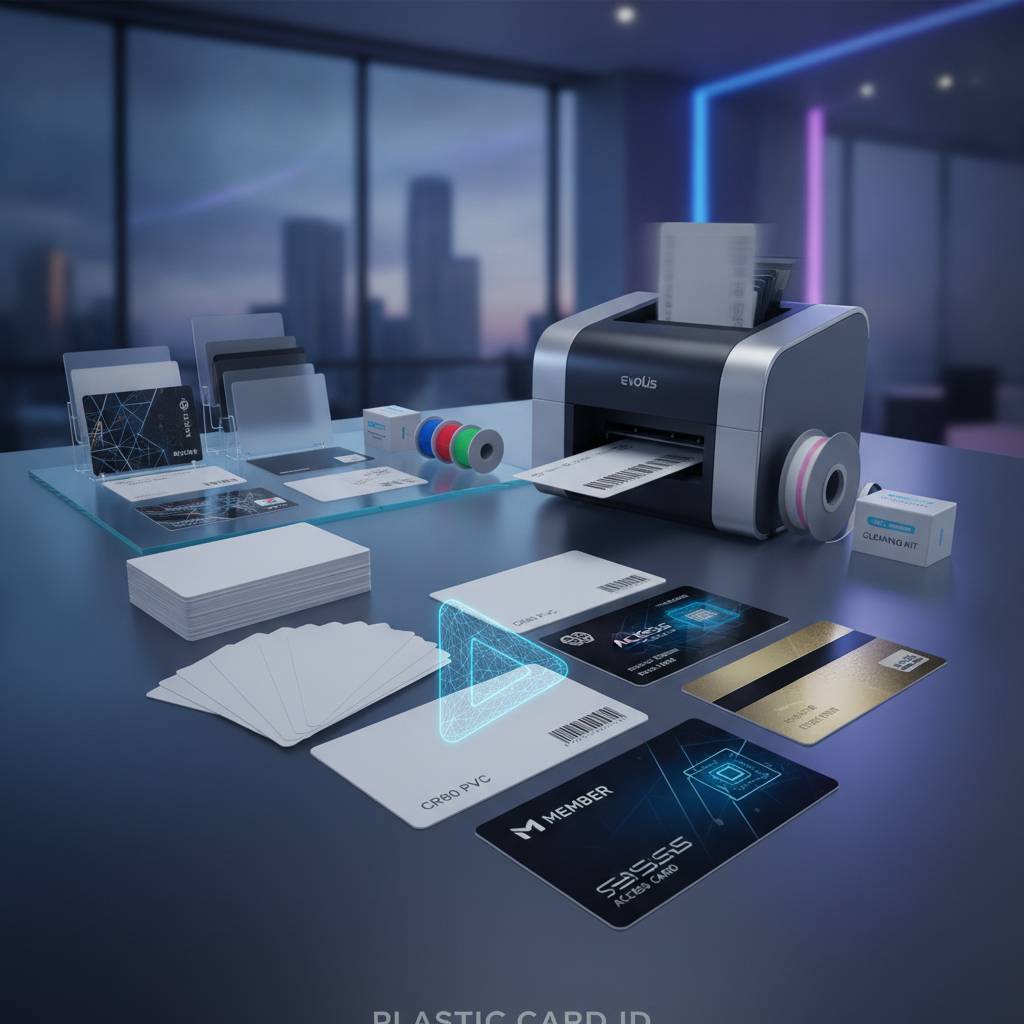
A plastic card printer is only as good as the supplies feeding it. Ribbons degrade. Cleaning rollers accumulate residue. Encoding modules need the right consumables to perform consistently. An organization that invests in quality hardware but cuts corners on supplies will see print quality suffer - and often attribute the problem to the printer itself when the real culprit is a low-grade ribbon or a skipped cleaning cycle.
Plastic Card ID supplies the full ecosystem of consumables and accessories that professional card printing programs require. This is not an afterthought - it is a core part of what makes CPE a genuine long-term partner rather than just a hardware vendor.
Printer Ribbons: Getting Color Right
The ribbon is one of the most important variables in card print quality. YMCKO ribbons - which combine yellow, magenta, cyan, black resin, and overcoat panels - are the standard choice for full-color card printing. They produce the rich, accurate color reproduction that professional ID cards and loyalty cards require. Monochrome ribbons serve applications where a single-color print is sufficient: black text, blue text, or specialty security colors.
Specialty ribbons extend printing capabilities further, enabling metallic finishes, fluorescent elements, and other effects that add visual distinction or security features to a card program. Matching the right ribbon to the right application is a detail that separates good card programs from great ones, and the Plastic Card ID team can guide that selection with precision.
Cleaning Kits and Maintenance Supplies
Card printers contain precision rollers, print heads, and transport mechanisms that accumulate dust, card debris, and ribbon residue over time. Neglecting regular cleaning is the single most common cause of declining print quality and premature hardware wear. Most manufacturers specify cleaning intervals - typically every few hundred cards - and following those intervals is the simplest way to protect a hardware investment.
Cleaning kits typically include pre-saturated cleaning cards, swabs, and roller cleaning accessories designed for specific printer models. These are not generic products - using the right cleaning kit for a specific printer model ensures effective maintenance without risking damage to sensitive components. CPE stocks cleaning supplies matched to every printer brand in the lineup.
Encoding Options, Hoppers, and Card Accessories
Many plastic card programs require more than just printed graphics. Magnetic stripe encoding embeds data in the card's magnetic track - the technology behind hotel key cards, loyalty programs, and time-and-attendance systems. Smart chip encoding takes security and data capacity further, enabling contactless access control and secure credential programs.
Input hoppers expand printer capacity for high-volume runs, allowing larger batches to process without manual card loading. Card carriers and sleeves protect finished credentials during distribution and daily use, extending the functional life of every card printed. These details matter - a beautifully printed card that arrives scratched or worn from poor handling is a missed opportunity.
What Organizations Are Using These Printers For
The applications for in-house plastic card printing are broader than most organizations initially realize. The most obvious use case - employee ID badges - is just the beginning. Once a card printer is in-house and the workflow is established, organizations routinely expand their programs to cover additional use cases they previously handled through outside vendors or not at all.
The following represents the range of card programs that Plastic Card ID customers run every day, across industries and organization types throughout the United States.
Employee ID and Access Control Cards
Employee ID cards are the backbone of most organizational card programs. They establish identity, communicate role and department, and in access-controlled environments, determine which doors and systems a person can reach. Printing these in-house means a new employee can have a fully functional, encoded access credential on their first day - not their third week.
With magnetic stripe or smart chip encoding built into the printer workflow, access control credentials are produced as part of the normal printing process. Security programs that depend on timely, accurate credential issuance benefit enormously from in-house production. Revocations can be handled just as quickly - the card is simply deactivated in the access control system.
Membership, Loyalty, and Student ID Cards
Membership organizations - gyms, professional associations, clubs, libraries - rely on cards that are both functional and representative of the brand. A loyalty card program works best when it can be updated, reissued, and customized without delay. Student ID programs at schools and universities demand reliable, photo-quality output at scale, often with integrated barcode or chip data for meal plans and library access.
All of these applications are well within reach for any organization using a mid-range printer from CPE's lineup. The key is matching the printer's throughput capacity to the program's actual volume - and that is a conversation the Plastic Card ID team has guided thousands of customers through successfully.
Hotel Key Cards, Event Badges, and More
Hotel operations represent one of the most volume-sensitive card printing use cases. Key cards need to be issued quickly at check-in, often personalized, and encoded accurately every time. The Evolis Primacy2 and similar mid-to-high-volume printers handle this smoothly. Event credentials - conference badges, venue passes, trade show IDs - often involve a spike in printing demand over a compressed time period, which is exactly the scenario the Matica Event Printer addresses.
Beyond these, organizations issue cards for visitor management, contractor identification, healthcare patient programs, transportation access, and countless other purposes. The common thread is that every card program benefits from the speed, accuracy, and control that in-house printing delivers.
Buyer Tips: Choosing the Right Plastic Card Printer
The printer market can feel overwhelming if you approach it without a framework. There are dozens of models across multiple brands, each with different specs, capabilities, and price points. The good news: the selection process becomes straightforward when you focus on the right variables in the right order. Volume first, features second, brand third.
Key Questions to Ask Before You Buy
Before evaluating specific printer models, answer these questions honestly. How many cards do you print - or expect to print - per month? Do you need dual-sided printing, or is single-sided sufficient? Do your cards need magnetic stripe or smart chip encoding? Will you need lamination for added card durability? Is color printing essential, or would monochrome serve your use case?
- Print volume determines your duty cycle requirement - match your printer's capacity to your actual output needs.
- Single vs. dual-sided printing affects cost per card and card design possibilities.
- Encoding requirements (magnetic stripe, smart chip, or both) narrow your hardware options significantly.
- Lamination adds durability and security, but requires a compatible module or overlay ribbon.
- Color vs. monochrome influences ribbon cost and print speed.
- Budget for consumables should be factored alongside hardware cost - ribbons and cards are ongoing expenses.
Answering these questions before engaging with a product list makes the selection process dramatically faster and eliminates the risk of buying hardware that does not actually fit your workflow. CPE customers who work through this process with the team almost always land on exactly the right printer on the first try.
Understanding Total Cost of Ownership
A printer priced at $400 and one priced at $900 may look very different upfront, but the real cost comparison happens over 12-36 months of operation. Ribbon cost per card, blank card pricing, cleaning supply frequency, and expected hardware lifespan all contribute to the true cost picture. A higher-quality printer that lasts five years with minimal maintenance often costs less than a cheaper unit replaced every two years.
The Plastic Card ID team can walk through a total cost projection for any printer in the lineup based on your expected volume. Call 800.835.7919 and give the team your basic parameters - cards per month, single or dual-sided, encoding needs - and they will give you a clear comparison that accounts for the full ownership timeline, not just the purchase price.
Planning for Program Growth
Card programs have a consistent tendency to grow. An organization that starts with 50 employee badges often expands to visitor management, contractor IDs, and loyalty cards within a year. Buying a printer with some headroom above your current volume is almost always the right call. Moving from a 1,000 card/year printer to a 3,000 card/month printer is a hardware purchase and a workflow disruption - both of which are easier to avoid by buying slightly ahead of current needs.
Modular printers that accept encoding upgrades, lamination modules, and expanded input hoppers offer the most flexibility for growing programs. Several models in the Plastic Card ID lineup are specifically designed with this upgradability in mind, making them smart long-term investments rather than static purchases.
Frequently Asked Questions About Plastic Card Printers
After 25 years and more than 100,000 customers, certain questions come up repeatedly. The following covers the most common ones - not as a formality, but because the answers genuinely help buyers make better decisions and run better card programs.
What Is the Difference Between Dye-Sublimation and Direct-to-Card Printing?
Most plastic card printers for business use operate on either a dye-sublimation or direct-to-card printing method. Dye-sublimation transfers ink from a ribbon onto the card surface using heat, producing smooth, photographic-quality color gradations. This is the standard for full-color photo ID cards. Direct-to-card printing applies ink directly to the card surface and is typically used for monochrome or simpler color applications.
For most professional card programs, dye-sublimation produces the cleanest, most impressive results. The printers in CPE's lineup use this technology across the Evolis, Fargo, and Zebra ranges, which is one reason output quality is consistently strong across all models in the catalog.
How Often Do Printer Ribbons Need Replacing?
Ribbon yield varies by printer model and ribbon type. A standard YMCKO ribbon for a mid-range printer typically yields 250-500 prints per roll, depending on card coverage and color density. Monochrome ribbons yield significantly more - often 1,000 or more prints per roll. Tracking ribbon consumption against card output gives you a reliable forecast for consumable costs and prevents the operational disruption of running out mid-batch.
Stocking two to three ribbon rolls in reserve is a standard practice for active card programs. CPE makes it straightforward to order ribbons matched to specific printer models, reducing the risk of compatibility errors that waste materials and time.
Can One Printer Handle Multiple Card Programs?
Absolutely - and this is one of the underappreciated advantages of in-house printing. A single mid-range printer can run employee ID badges in the morning, loyalty card reprints in the afternoon, and visitor badges on demand throughout the day. Each job uses the same hardware; only the card template and data change. Consolidating multiple card programs onto a single piece of hardware is both operationally efficient and cost-effective.
The practical limitation is volume. If multiple programs collectively push print volume above the printer's recommended monthly duty cycle, it is time to consider a higher-capacity unit or a second printer. For most organizations, a well-chosen mid-range printer handles the full scope of card programs without strain.
Connect With Plastic Card ID and Get the Right Printer Today
There is no version of this decision that benefits from delay. Every week an organization spends waiting on an outside vendor for employee badges, membership cards, or access credentials is a week of avoidable friction, cost, and lost control. The equipment to eliminate that friction entirely is available, proven, and supported by a team that has been doing this longer than most of the industry.
Plastic Card ID has matched over 100,000 customers to the right plastic card printer for their specific needs. The lineup spans every volume tier, every major brand, and every common use case - from the Evolis Badgy200 for small organizations to the Matica Event Printer for high-speed event production, and everything in between. Ribbons, cleaning kits, encoding modules, hoppers, card sleeves - the full supply chain is covered.
The right plastic card printer for your organization exists in this lineup. Call Plastic Card ID today at 800.835.7919 and let a product specialist match your volume, use case, and budget to exactly the right hardware. In-house printing starts with one conversation - make it today.
Previous Page