Buy Plastic Card Printer: Best Deals and Trusted Brands
Table of Contents []
- Why Smart Businesses Choose Plastic Card ID When They Buy a Plastic Card Printer
- Understanding the Printer Lineup Before You Buy a Plastic Card Printer
- Supplies and Accessories: Everything That Keeps Your Program Running
- Buyer's Guide: How to Choose the Right Plastic Card Printer for Your Organization
- Common Use Cases: Real Organizations, Real Card Programs
- Frequently Asked Questions About Buying a Plastic Card Printer
- Ready to Buy a Plastic Card Printer? Plastic Card ID Has Your Solution
Why Smart Businesses Choose Plastic Card ID When They Buy a Plastic Card Printer
There's a moment every organization hits - the realization that outsourcing card production is eating time, money, and control. Maybe your vendor missed a deadline. Maybe the per-card cost finally stopped making sense. Whatever triggered the shift, the decision to bring card printing in-house is one of the most operationally sound moves a business can make. And when that moment arrives, Plastic Card ID is the name tens of thousands of U.S. businesses have trusted to get it right.
With over 25 years of experience and a customer base exceeding 100,000 organizations, CPE has built something rare in the hardware supply space: genuine expertise matched with genuine product depth. This isn't a general electronics retailer that happens to stock a card printer or two. This is a dedicated, curated operation built entirely around helping businesses find, buy, and run professional plastic card printing programs.
From solo HR departments printing a handful of employee badges per month to university systems cranking out thousands of student IDs each semester, the range of use cases is wide - and the printer lineup here matches that range precisely. Let's break down everything you need to know before you buy a plastic card printer.
The Real Cost of Outsourcing Card Production
When you send your card jobs to an outside vendor, you're paying for their equipment, their labor, their overhead, and their profit margin. You're also waiting - sometimes days, sometimes weeks - for a batch that might arrive with errors you can't fix on the spot. In-house printing eliminates every one of those friction points.
Consider what print-on-demand actually means in practice. A new employee starts Monday. Their badge is ready Monday. A member loses their card Friday afternoon. You reprint it Friday afternoon. That level of responsiveness isn't just convenient - it's a competitive differentiator that reflects well on your organization every single day.
Who Is Plastic Card ID and What Makes Them Different
CPE has been supplying plastic card printers and related hardware to businesses across the United States since the industry was still finding its footing. That history matters - it means the team understands not just the equipment, but the workflows, the pain points, and the edge cases that only surface after years of real-world deployments.
The product lineup is deliberately focused. Rather than stocking dozens of mediocre brands, Plastic Card ID carries professional-grade equipment from Evolis, Fargo, Zebra, and Matica - four names that consistently dominate the card printer market for very good reasons. Each brand brings specific strengths, and knowing which one fits your needs is exactly the kind of guidance CPE is positioned to provide.
What Can You Print? The Full Scope of Card Programs
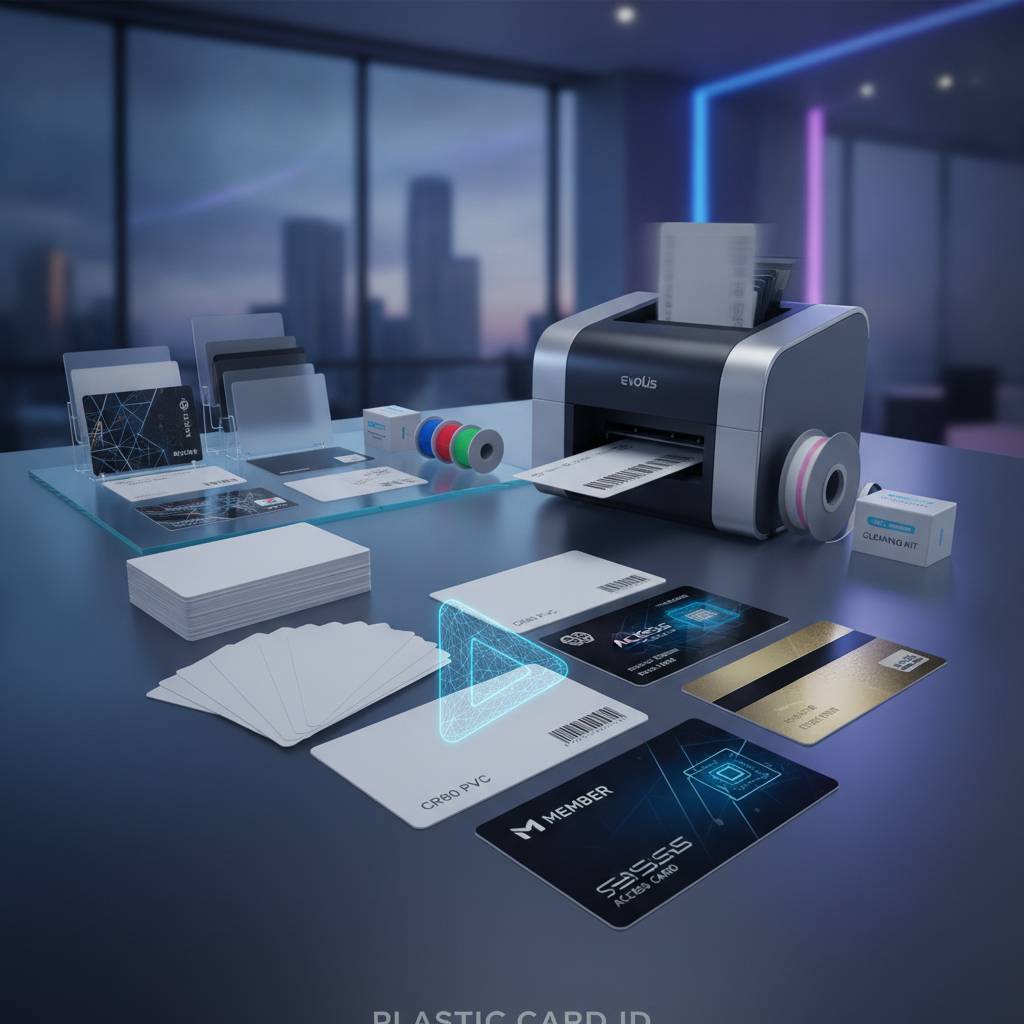
The applications are broader than most people initially realize. Employee ID cards are the obvious starting point, but the same printer that produces those can also handle membership cards, loyalty cards, access control credentials, student IDs, hotel key cards, and event badges. One piece of hardware, an entire ecosystem of card programs.
Each of these use cases comes with its own encoding and personalization requirements. An employee badge might need a magnetic stripe. A student ID might require a smart chip. An event credential might just need a high-quality color print with a barcode. The printers and accessories available through Plastic Card ID cover every combination of these needs cleanly and professionally.
| Printer Model | Brand | Best For | Volume Range | Key Features |
|---|---|---|---|---|
| Badgy200 | Evolis | Small organizations, startups | Under 1,000 cards/year | Compact, plug-and-play, color printing |
| Zenius | Evolis | Growing teams, single-sided | 1,000-6,000 cards/month | USB/Ethernet, ribbon saving mode |
| Primacy2 | Evolis | Mid-range dual-sided needs | 1,000-6,000 cards/month | Duplex printing, mag stripe encoding |
| Agilia | Evolis | Premium, edge-to-edge quality | High-volume professional | Borderless printing, superior color output |
| Fargo Series | Fargo (HID) | Security ID programs | Mid to high volume | HoloKote overlay, smart card encoding |
| Zebra Series | Zebra | Enterprise ID, access control | Mid to high volume | Durable build, network-ready |
| Matica Event Printer | Matica | On-site event badge printing | High-speed bursts | Fast throughput, event-optimized |
Understanding the Printer Lineup Before You Buy a Plastic Card Printer
Choosing the right printer isn't about picking the most expensive option or defaulting to whatever a tech forum recommends. It's about matching hardware capabilities to your actual production volume, card design requirements, and encoding needs. Get that match right, and the printer becomes a seamless part of your workflow. Get it wrong, and you're either overpaying for capacity you'll never use or bottlenecking operations with a unit that can't keep up.
CPE structures the lineup in a way that makes this decision genuinely easier. There's a clear progression from entry-level through mid-range to premium and high-throughput systems, with each tier serving a well-defined segment of the market. Here's how it breaks down in practical terms.
Entry-Level: The Evolis Badgy200 for Low-Volume Needs
Not every organization needs a workhorse. A small nonprofit printing volunteer badges twice a year, a boutique hotel issuing a handful of key cards per week, a startup with ten employees - these operations don't need industrial capacity. They need something reliable, simple to operate, and capable of producing professional-looking cards without a steep learning curve. The Evolis Badgy200 is built for exactly that context.
At under 1,000 cards per year, the Badgy200 delivers full-color printing from a compact footprint that sits comfortably on any desk. Plug it in, load the ribbon and cards, and you're printing within minutes. It's an ideal first printer for organizations that are new to in-house card production and want to start without overcommitting to hardware.
Mid-Range Workhorses: Evolis Zenius and Primacy2
Step up in volume and requirements, and the Zenius and Primacy2 become the obvious choices. Both are built to handle 1,000 to 6,000 cards per month comfortably, making them the right fit for mid-sized businesses, schools, healthcare facilities, and membership organizations with ongoing card issuance programs. The Zenius handles single-sided printing cleanly and efficiently, while the Primacy2 adds duplex printing capability for cards that need information on both sides.
The Primacy2 also supports magnetic stripe encoding as an upgrade option - a significant feature for organizations issuing access control cards, loyalty cards, or any credential that needs to interface with a card reader. This is where professional card printing really starts to flex its capabilities, moving beyond simple visual personalization into functional, encoded credentials that work within broader physical security and membership systems.
Premium Output: The Evolis Agilia
For organizations where card quality is non-negotiable - think premium membership clubs, upscale hospitality brands, or any operation where the card itself reflects directly on brand perception - the Evolis Agilia sets the standard. Edge-to-edge printing, exceptional color fidelity, and the kind of output that genuinely impresses are the defining characteristics of this printer.
The Agilia isn't about raw volume; it's about quality at a professional level that closes the gap between in-house production and what you'd expect from a commercial print shop. When the card is part of the brand experience, the Agilia is the right tool. Contact CPE at 800.835.7919 to discuss whether this model fits your specific quality requirements.
Fargo, Zebra, and Matica: Security and Speed
Fargo printers, produced under the HID Global umbrella, bring a security-first design philosophy that makes them popular choices for government agencies, corporate campuses, and any organization running a formal access control program. Features like HoloKote security overlays and robust smart card encoding capabilities make these printers more than just output devices - they're security infrastructure.
Zebra card printers complement the lineup with enterprise-grade durability and network connectivity that integrates smoothly into large-scale IT environments. And for organizations that need to print badges fast - at trade shows, conferences, sporting events, or on-site registration scenarios - the Matica Event Printer delivers the high-speed throughput that makes on-demand event credentialing actually viable. Each brand solves a specific set of problems at a professional level.
Supplies and Accessories: Everything That Keeps Your Program Running
A printer purchase is the beginning, not the end. The ongoing health and output quality of your card printing program depends on consistently using the right supplies - the right ribbons, the right cleaning materials, the right lamination, the right encoding hardware. Cutting corners on consumables is the fastest way to degrade print quality and shorten printer lifespan.
Plastic Card ID supplies the full range of consumables and accessories needed to keep any card printing operation running at full capacity. This isn't an afterthought - it's a core part of what makes CPE a one-stop resource rather than just a hardware vendor.
Printer Ribbons: YMCKO, Monochrome, and Specialty Options
Ribbon selection is more nuanced than it first appears. YMCKO ribbons - yellow, magenta, cyan, black, and overlay - are the standard for full-color card printing, delivering vibrant, protected output across most professional card applications. Monochrome ribbons are the right call when you're printing single-color cards at high volume and need to keep per-card costs down without sacrificing professional appearance.
Specialty ribbons handle specific requirements: resin-only formulations for text and barcode printing, silver or gold ribbons for premium visual effects, scratch-off ribbons for promotional card applications. Using the manufacturer-recommended ribbon for your specific printer model isn't just best practice - it's the difference between consistent output and frustrating inconsistency.
Cleaning Kits and Maintenance Supplies
Card printers are precision devices. Dust, debris, and residue from cards and ribbons accumulate over time and degrade output quality in ways that aren't always immediately obvious. Regular cleaning - using the proper cleaning cards and swabs designed for your specific printer model - maintains the print head and card transport mechanism in the condition that produces sharp, consistent results.
Plastic Card ID stocks cleaning kits matched to the printer brands in the lineup. A simple, regular cleaning routine is the single most effective way to extend printer life and protect your hardware investment. It takes minutes and prevents the kind of gradual output degradation that eventually forces a costly service call or premature hardware replacement.
Lamination, Encoding, and Input Hoppers
Lamination modules add a protective topcoat to printed cards that dramatically increases durability and scratch resistance - essential for cards that see heavy daily use like employee badges or student IDs. Encoding upgrades for magnetic stripe and smart chip extend the functional range of your card program beyond visual output into the realm of functional, machine-readable credentials.
Input hoppers expand the card capacity of printers that support them, reducing the frequency of manual reloading for high-volume print runs. Card carriers and sleeves protect finished cards during distribution and storage. These accessories aren't optional extras - for many card programs, they're fundamental operational requirements.
Buyer's Guide: How to Choose the Right Plastic Card Printer for Your Organization
The decision to buy a plastic card printer involves more variables than most buyers initially anticipate. Getting it right the first time requires an honest assessment of current needs alongside a realistic projection of future requirements. Buying too small creates bottlenecks; buying too large wastes capital. Here's a structured approach to finding the right fit.
Step One: Assess Your Volume and Card Type Requirements
Start with volume. How many cards do you print per month - or per year if your operation is seasonal? Factor in growth. If you're at 200 cards per month now but expect to double that within 18 months, buying an entry-level printer today means buying again sooner than you'd like. Project 24 months out when evaluating volume requirements.
Then consider card type. Single-sided or dual-sided? Full color or monochrome? Do the cards need to be encoded - magnetic stripe, smart chip, or contactless? Each of these requirements narrows the field and points toward specific models. A card program with encoding requirements, for instance, immediately moves past entry-level options into mid-range or premium territory.
Step Two: Factor In Connectivity and Integration
Where will the printer live, and how will it connect to your systems? A USB-connected desktop printer works fine in a small office where one person manages card production. A larger operation distributing print jobs across departments needs network connectivity - Ethernet or Wi-Fi - and a printer that supports it cleanly.
Integration with existing software - whether that's an HR system, an access control platform, or a membership management application - is another consideration. The right printer should fit into your workflow, not require you to build a workflow around it. CPE can help evaluate compatibility based on your existing systems.
Step Three: Calculate True Cost of Ownership
The printer's purchase price is one data point, not the full picture. Ribbon costs per card, cleaning supply requirements, any encoding upgrade costs, and eventual print head replacement all factor into the true cost of operating the printer over its lifespan. For high-volume operations especially, per-card consumable cost has a significant impact on total program economics.
- Entry-level printers (like the Badgy200) typically run $200-$400 in hardware cost with per-card consumable costs appropriate for low-volume use
- Mid-range printers (Zenius, Primacy2) fall in the $500-$1,200 range with better per-card economics at higher volumes
- Premium and security-focused printers (Agilia, Fargo, Zebra) range from $1,200-$3,500 with enterprise-grade consumable options
- High-speed event printers (Matica) are priced for the throughput they deliver in time-sensitive scenarios
- Factor ribbon yield (cards per ribbon panel) into per-card cost calculations before comparing models
Common Use Cases: Real Organizations, Real Card Programs
Understanding how other organizations use in-house card printing can help clarify whether a specific configuration makes sense for your context. The applications are diverse - but the underlying value proposition is consistent: control, speed, and professional quality delivered on your schedule.
Employee ID and Access Control Programs
Corporate HR departments and facility security teams are among the most common buyers in this space, and for good reason. Employee turnover, contractor access, visitor management - these all create ongoing card issuance demands that benefit enormously from on-demand printing. A new hire's badge ready on day one isn't a luxury; it's a baseline expectation that in-house printing makes effortlessly achievable.
Access control programs specifically benefit from printers with encoding capabilities. Magnetic stripe or smart chip encoding built into the card during printing means a single-step issuance process rather than a two-step print-then-encode workflow. This is where mid-range and premium printer models pay for themselves quickly in operational efficiency alone.
Schools, Universities, and Student ID Programs
Educational institutions face some of the highest-volume, most time-sensitive card issuance scenarios in the market. The beginning of a school year brings hundreds or thousands of student IDs that need to be produced in a compressed window. A mid-range printer like the Primacy2, or a high-volume system for larger institutions, handles these peak demands without requiring outsourcing to a vendor who may not share your urgency.
Student IDs often serve multiple functions: building access, library privileges, meal plan integration, transportation passes. Encoding capabilities make a single card do the work of several separate credentials - simplifying the student experience while consolidating the institution's card program into a single, controllable system.
Membership Organizations, Hotels, and Events
Gyms, clubs, associations, and loyalty programs all depend on membership cards that reflect brand quality while serving a functional purpose. Hotel key cards need to be reprogrammable and reliably produced - a front desk running out of key cards at check-in is a guest experience failure that in-house printing prevents entirely.
Event credentials - conference badges, festival wristbands, trade show passes - often need to be produced on-site, in volume, in real time. The Matica Event Printer exists specifically to meet this demand. On-site badge printing transforms event registration from a bottleneck into a smooth, professional experience that sets a positive tone from the moment an attendee arrives. Contact CPE at 800.835.7919 to discuss the right solution for your event credentialing needs.
Frequently Asked Questions About Buying a Plastic Card Printer
Before committing to a purchase, most buyers have a consistent set of questions. Here are honest, direct answers to the ones that come up most often when organizations are evaluating whether to buy a plastic card printer and which model to choose.
How difficult is it to set up and operate a card printer?
Entry-level models like the Evolis Badgy200 are designed for ease of use from the ground up - minimal setup, intuitive software, and a process that most users are comfortable with after printing their first few cards. Mid-range and premium printers add more configuration options but remain accessible to non-technical users. Most organizations are printing production-quality cards within hours of unboxing, not days.
The learning curve is steepest around card design software and encoding configuration, not the physical printer itself. CPE can point buyers toward appropriate design tools and provide guidance on encoding setup for specific use cases, reducing the friction of getting a new program off the ground.
What cards work with these printers?
The printers in this lineup are designed to work with standard CR80 PVC plastic cards - the same dimensions as a credit card. Thickness matters: most card printers are designed for 30 mil standard cards, though some models can handle varying thicknesses. Pre-punched cards, cards with magnetic stripes, and cards with embedded smart chips are all available and compatible with the appropriate printer configurations.
Plastic Card ID can advise on card stock selection based on the specific printer and use case. Using the correct card stock is as important as using the correct ribbon - both directly affect output quality and printer longevity. This is one area where it genuinely pays to ask rather than assume.
What is the lifespan of a professional card printer?
With proper maintenance - regular cleaning, correct ribbon usage, appropriate card stock - a professional-grade card printer from Evolis, Fargo, or Zebra will deliver years of reliable service. Print head longevity is often measured in the millions of card passes for commercial-grade units. The investment is durable when the printer is treated correctly.
Neglecting cleaning routines and using non-recommended supplies accelerates wear significantly. This is why Plastic Card ID emphasizes stocking appropriate maintenance supplies alongside printer hardware - protecting the hardware investment over the long term is part of what the full supply relationship provides.
Ready to Buy a Plastic Card Printer? Plastic Card ID Has Your Solution
The decision to bring card printing in-house is straightforward once you understand what it delivers: control over your card program, elimination of vendor lead times, per-card cost reduction at volume, and the ability to personalize and encode every card you produce exactly as needed. These are durable operational advantages that compound over time as your card program grows and your familiarity with the equipment deepens.
Plastic Card ID brings over 25 years of dedicated experience in the plastic card printer space to every conversation. The lineup - Evolis, Fargo, Zebra, Matica - covers every production scenario from the smallest office to the largest enterprise. The supply catalog covers every consumable and accessory a card program requires. And the knowledge behind it all comes from decades of helping organizations just like yours get their card programs running right.
Get the Right Printer for Your Needs
Not sure which model fits your volume and card type requirements? That's exactly the kind of question CPE is set up to answer. The selection process is easier when you have a knowledgeable resource walking through the options with your specific context in mind rather than evaluating spec sheets in isolation. The right printer is the one that matches your actual workflow - and finding it starts with a conversation.
Whether you're printing 200 cards a year or 20,000 cards a month, there's a professionally appropriate solution in this lineup. Call 800.835.7919 and let CPE help you identify it quickly and confidently.
Browse the Full Lineup and Supplies Catalog
From the Evolis Badgy200 to the Matica Event Printer, from YMCKO ribbons to lamination modules and encoding upgrades, everything your card program needs is available through Plastic Card ID. This is a one-stop resource built for serious card printing operations - not a general retailer hoping you happen to need what they have in stock.
Professional tools, professional results, professional support. That's what over 100,000 U.S. customers have come to expect from CPE, and it's what your organization will find when you're ready to buy a plastic card printer and build a card program that actually works.
Contact Plastic Card ID today at 800.835.7919 and take the first step toward a card printing program that delivers professional results on your schedule, every time.
Previous Page